
El Niño tightens grip on Pacific as authorities warn of drought and extreme weather
Lachlan EddieFri, 23 Oct

SPREP Director-General Sefanaia Nawadra regrets United States' exit from regional agency, as data shows 2025 was one of the warmest years in the Pacific.
Photo/SPREP
Pacific islands face rising temperatures and climate threats as the US withdraws support from regional environment agency SPREP, while China steps in to help fill the gap.




The Pacific recorded some of its warmest years on record in 2025, continuing a long-term trend of rising temperatures across the region, according to the Secretariat of the Pacific Regional Environment Programme (SPREP).
Using ERA5 climate data from the Copernicus Climate Change Service, SPREP reports 2025 was “the fifth warmest year ever recorded in the western Pacific”. Alarmingly, all five of the hottest years have occurred since 2016.
Average regional temperatures in 2025 were about 0.65°C above the 1961-1990 baseline, with long-term warming in the Pacific increasing by roughly 0.1°C per decade since 1940.
SPREP says the findings reinforce the urgent need for climate adaptation and resilience across Pacific island countries, which are among the most vulnerable in the world to sea-level rise, extreme weather, and ecosystem disruption.
The Sāmoa-based regional body has also expressed regret at the United States’ decision to withdraw from SPREP.
In a separate statement on Friday, SPREP Director-General Sefanaia Nawadra says the organisation’s priority remains protecting Pacific communities.
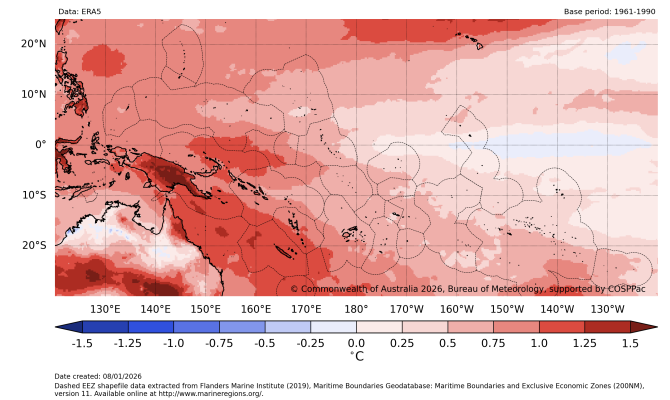
According to ERA5, a global climate dataset from the Copernicus Climate Change Service, 2025 was the third warmest year on record worldwide, following 2024 and 2023. In the western Pacific, it ranked fifth warmest since 1940, with January, February, March, May, and October all among the hottest months ever observed. Photo/SPREP
Nawadra says the announcement by the US of its withdrawal from SPREP - being one of 66 international bodies deemed to be ‘contrary to US national interests’ - is an early challenge for the year.
“A lot of questions were asked about the implications, especially in the face of a fiercely contested region, geopolitically,” he says.
“The biggest potential loss for us, apart from the political presence of the US as a valued member, is the many strong working relationships we have built with US technical agencies and organisations.
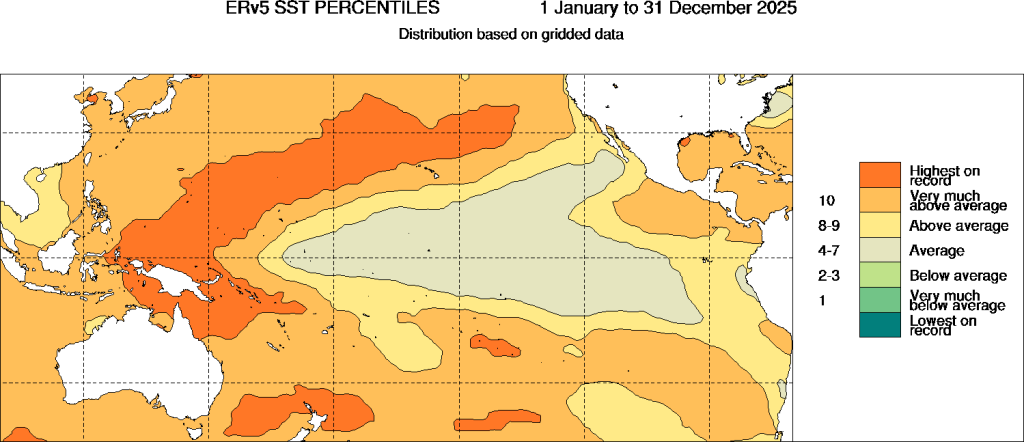
In 2025, unusually warm conditions were especially strong over the western equatorial Pacific and the Coral Sea, including areas around Papua New Guinea and New Caledonia. These patterns are likely linked to record high sea surface temperatures in the same areas. Photo/SPREP.
“We respect the sovereignty of the United States in making this decision, but I am comforted that all our actions have been within the mandate given to us by our members.
“Our Pacific leaders have repeatedly stated that climate change represents the single greatest threat to our people, threatening livelihoods, security, and our very existence. We as a region remain in a state of climate emergency,” Nawadra says.
Despite the US withdrawal, other partners continue to support Pacific climate programmes. Last month, China stepped in to fill the funding gap, providing US$200,000 (about NZ$333,000) in voluntary funding to SPREP, extending a partnership that has been in place since 1998.
In 2024, the US contributed about US$190,000 (about NZ$318,000), at the time making it SPREP’s second-largest government backer and accounting for roughly 15 per cent of member-state funding.

In January 2026, China presented financial assistance to SPREP for climate change resilience and environmental protection. Chinese Ambassador Fei Mingxing and Clark Peteru of SPREP are pictured at the presentation in Apia. Photo/SPREP.
Nawadra says the new support helps SPREP maintain vital climate work in the Pacific and ensures countries can continue building resilience against rising seas, extreme storms, and other climate impacts.
As temperatures rise and climate threats grow, Pacific nations are calling for stronger global action while continuing to protect communities on the front lines of the climate crisis.
Watch the presentation of financial assistance from China to SPREP below.