Tongan workers in line for jobs as FIFA-backed soccer turf takes shape
Elton Lonaratha JnrThu, 08 Oct

A population report raises calls for better long-term strategies for our future, more diverse communities
Photo/File/Canva/Massey University
A report warns that by 2043, New Zealand will have 2.5 workers for every retiree, leaving a young, lower-paid Pacific and Māori workforce to support them.



In the 1960s, New Zealand had a "safety in numbers" approach to retirement. There were seven workers for every one retiree. But that world is disappearing.
A new report from the Koi Tū Centre for Informed Futures reveals a looming population crunch.
Within 20 years, that ratio will drop to just 2.5 workers per retiree. Because our Pacific and Māori communities are the only ones with a large, young population, the survival of Aotearoa’s pensions and hospitals will soon depend almost entirely on them.
While the total population is getting older, Pacific people are staying young. Stats NZ 2023 Census data shows the median age for Pacific people is 24.9, compared with 38.1 for everyone else. Around half of Pasifika are under 25.
But there is a major problem. While these young people are being asked to fund the future, they are starting from the back of the pack.

NZ Europeans will make up around half (55 per cent) of the population by 2043. Photo/Canva
The report points to a massive "wealth gap." Today’s retirees, mostly of European descent, hold most of the country’s houses and savings. But only 20 per cent of Pacific people own their own home, compared to 60 per cent of European New Zealanders.
This means we are heading toward a future where a younger, lower-wealth workforce is being taxed to support an older, wealthier group of retirees.
Polly Atatoa Carr, Associate Professor from Te Ngira Institute for Population Research, says this makes investment in Pacific youth critical.
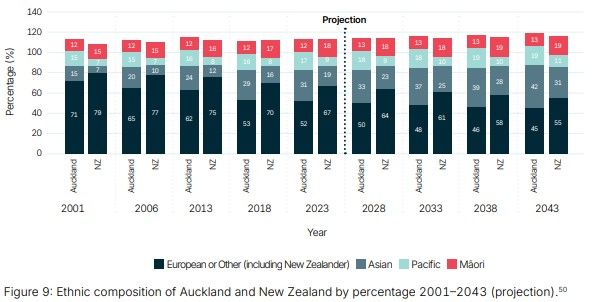
The report projects show Europeans will be the minority in Auckland in the next decade. Photo/Koi Tū
“We need to make sure that our young Māori, our young Pacific are as healthy, educated and supported as possible because they are going to be supporting us,” she tells PMN News.
The report warns that if we don’t fix the education system, New Zealand will suffer if Pacific students aren’t reaching the same levels of university entrance and high-skilled jobs as others, the "tax pot" won't be big enough to pay for Superannuation or the health system.
If that happens, the government might be forced to raise the retirement age even higher or cut back on the pension.
Professor Paul Spoonley, who co-authored the report, says New Zealand needs a long-term plan that doesn’t change every time there is an election.
“Demographic trends unfold over decades, but policy often focuses on short-term pressures like housing and labour,” he said in a statement.
Watch Paul Goldsmith's full interview below.
Pacific Peoples Minister Paul Goldsmith agrees the stakes are high.
“It’s important that the Pacific generation coming through are doing well,” he told William Terite on Pacific Mornings. “Good quality education is the most important thing long term.”
Goldsmith says the government is focusing on improving school attendance, improving health check-ups, and helping people into housing and jobs.
Without stronger planning and investment, the report warns New Zealand risks placing growing economic responsibility on younger communities that have not shared equally in the country’s wealth.