Online vault aims to return Pacific research to the community
Aui'a Vaimaila Leatinu'uWed, 21 Oct

Photo/Australian government
Six people have been charged in Fiji, highlighting the region’s growing role as a key transit route for international drug syndicates.

Pacific authorities have dealt a major blow to international drug trafficking, with separate but closely timed operations in French Polynesia/Tahiti and Fiji seizing tonnes of suspected cocaine.
In Tahiti, local authorities intercepted a suspicious vessel within the territory’s maritime zone last week, uncovering 96 bales of cocaine - a record seizure for the territory.
French officials said the shipment originated in Central America and was en route through the Pacific towards the southwest Pacific region.
While the drugs were not intended for French Polynesia, authorities warned the territory is increasingly a key transit point along international trafficking routes.
Local media reported that the operation involved the armed forces in French Polynesia (FAPF), the national gendarmerie, and the local branch of the anti-narcotics office (OFAST).
Thousands of kilometres away, Fijian police conducted a raid at Vatia Wharf in Tavua on the same day, seizing more than 100 bags of a white substance believed to be cocaine.
Six people have been charged: Four Ecuadorian nationals face charges for unlawful importation and possession of illicit drugs, as well as unlawful entry into Fiji.
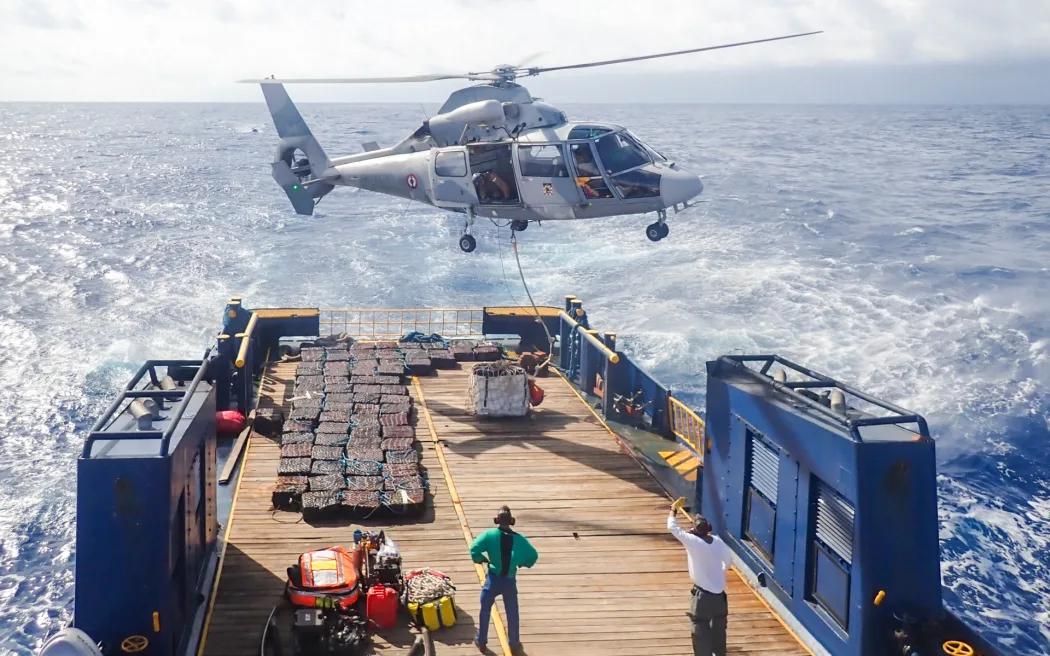
Authorities carry out a major operation targeting transnational drug trafficking in the Pacific. Photo/Facebook/Haut-commissaire de la République en Polynésie française
A 26-year-old man from Ba has been charged with unlawful importation, two counts of unlawful possession of illicit drugs, and serious assault.
Another man from Ba, aged 39, has been charged with unlawful possession of illicit drugs and serious assault. Authorities are continuing investigations into other possible suspects.
The Fiji Police Force said specialist units from the Criminal Investigations Department'S Serious Organised Crime and Intelligence unit and the Western Division Taskforce carried out the intelligence-led operation.
Watch the heavy police presence at a Fiji police station following the major drug seizure in Vatia, Tavua, below.
Inquiries into the source, destination, and scale of the seized drugs are ongoing.
Fiji’s Prime Minister, Sitiveni Rabuka, said the operations demonstrated the government’s commitment to fighting organised crime. “For Fiji, fighting transnational organised crime includes our maritime space,” he told local media.
“Regional cooperation is key, where the RFMF, the Fiji Navy, will operate with our regional partners to deter, disrupt and dismantle criminal syndicate networks and their business model,” Rabuka says, referring to the military forces.
Fiji has been grappling with a surge in methamphetamine abuse and trafficking, described by authorities as a “drug pandemic.”
The timing of the seizures has drawn attention to the Pacific Ocean as a critical corridor for cocaine moving from the Americas towards markets in Australia, New Zealand, and beyond.
The Australian Federal Police (AFP) congratulated Tahiti authorities on the interception, which involved a ship reportedly flying Togo’s flag and bound for Australia.
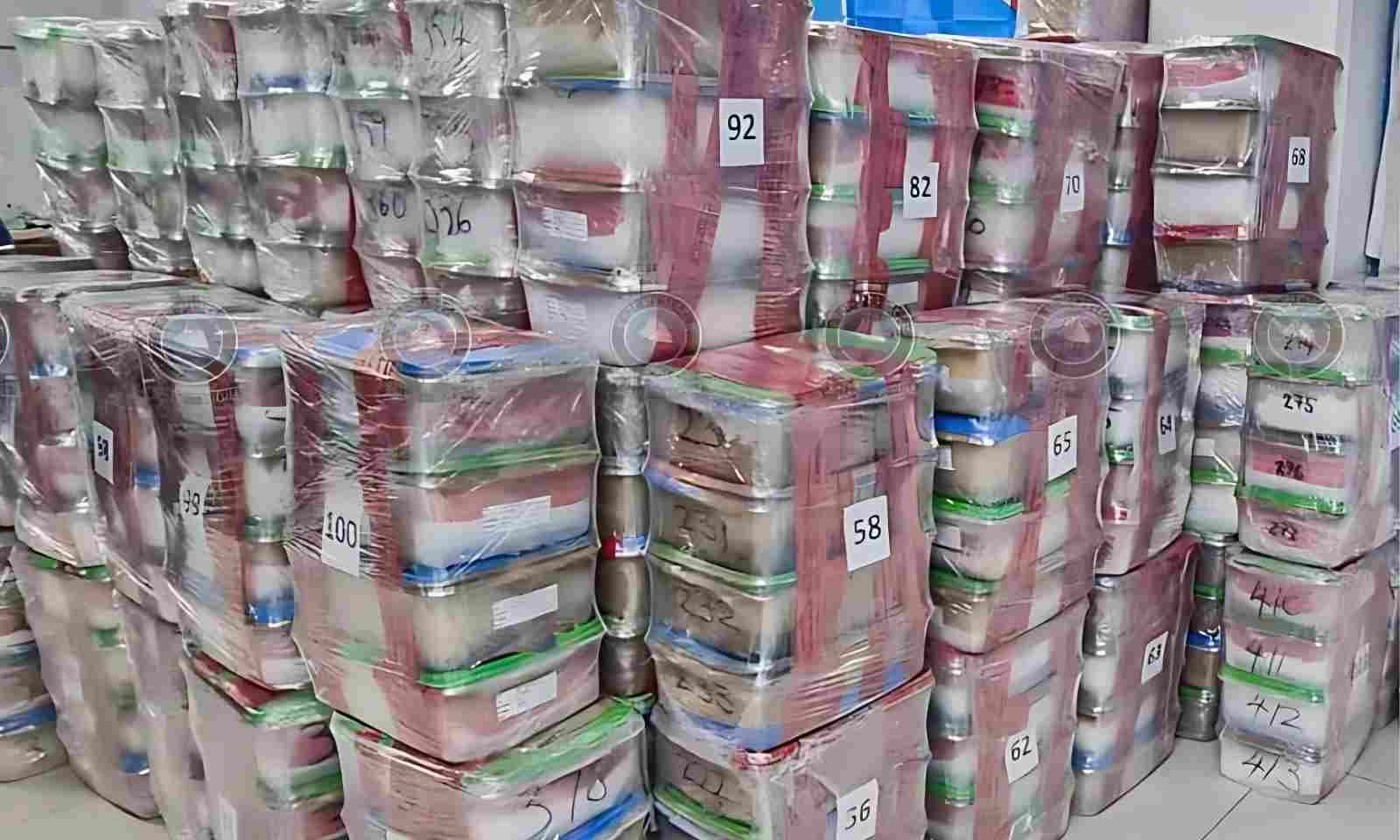
In a separate operation, more than four tonnes of methamphetamine was seized by police in Fiji in January. Nine locals were sentenced to prison last year for the involvement. Photo/Supplied
Stephen Jay, the AFP's commander, said staff posted across the Pacific, along with Taskforce Thunder, would work with French Polynesia to identify those linked to the shipment.
“I would like to thank the exceptional work of our partners in French Polynesia, who have prevented a significant amount of illicit drugs from reaching Australia,” Jay told the Gulf News.
“The harm caused by organised crime syndicates attempting to import illicit drugs into Australia is significant, and extends beyond individual users to a myriad of violent and exploitative crimes.”
Linda Cappello, acting commander of the Australian Border Force, also highlighted the value of regional partnerships.
“For those seeking to exploit maritime and supply chains to move illicit drugs, the message is clear: coordinated vigilance across the region significantly increases the risk of detection and disruption,” she said in a statement.
Pacific authorities say the twin operations highlight the evolving tactics of transnational criminal networks, which increasingly rely on long-range maritime routes, remote landing points, and international crews to evade detection.