
Visa-free travel and wage freezes spark fresh split in Pacific candidates debate
Christine RovoiWed, 21 Oct

TUSI owner Noeleen Tuala has launched a new Tongan bilingual diary, Palani Faka’aho, to help keep Lea Faka-Tonga alive through everyday writing.
Photo/Supplied
From a new bilingual diary in Aotearoa to a first song written entirely in Tongan, Pacific communities are finding everyday ways to keep Lea Faka-Tonga alive.


For Noeleen Tuala, keeping the Tongan language alive starts with something simple: giving people a place to write it down.
The owner of Pacific stationery brand, TUSI, has released a new Tongan bilingual diary, Palani Faka’aho, after noticing there was little Pacific language stationery available beyond Sāmoan.
“Being half Tongan, the first thing on my agenda was to create a Tongan diary,” Tuala tells John Pulu on PMN Tonga.
She bought TUSI in October last year and launched the diary during Tongan Language Week.
The diary includes “lotu, hiva, phrases, greetings, beautiful artwork and it's a beautiful book,” she.
Tuala, who also owns Pacific baby essentials brand PELE, says she has noticed more families returning to writing things down.
Watch Noeleen Tuala's full interview below.
“It’s just such a nice way to record everything, you can put your village in, you can write your goals down and it's nice to go back to when we would write things down,” Tuala says.
She hopes Palani Faka’aho will support people on their language journey and encourage the importance of Lea Faka-Tonga, the Tongan language.
TUSI hopes to release books in other Pacific languages in the future.
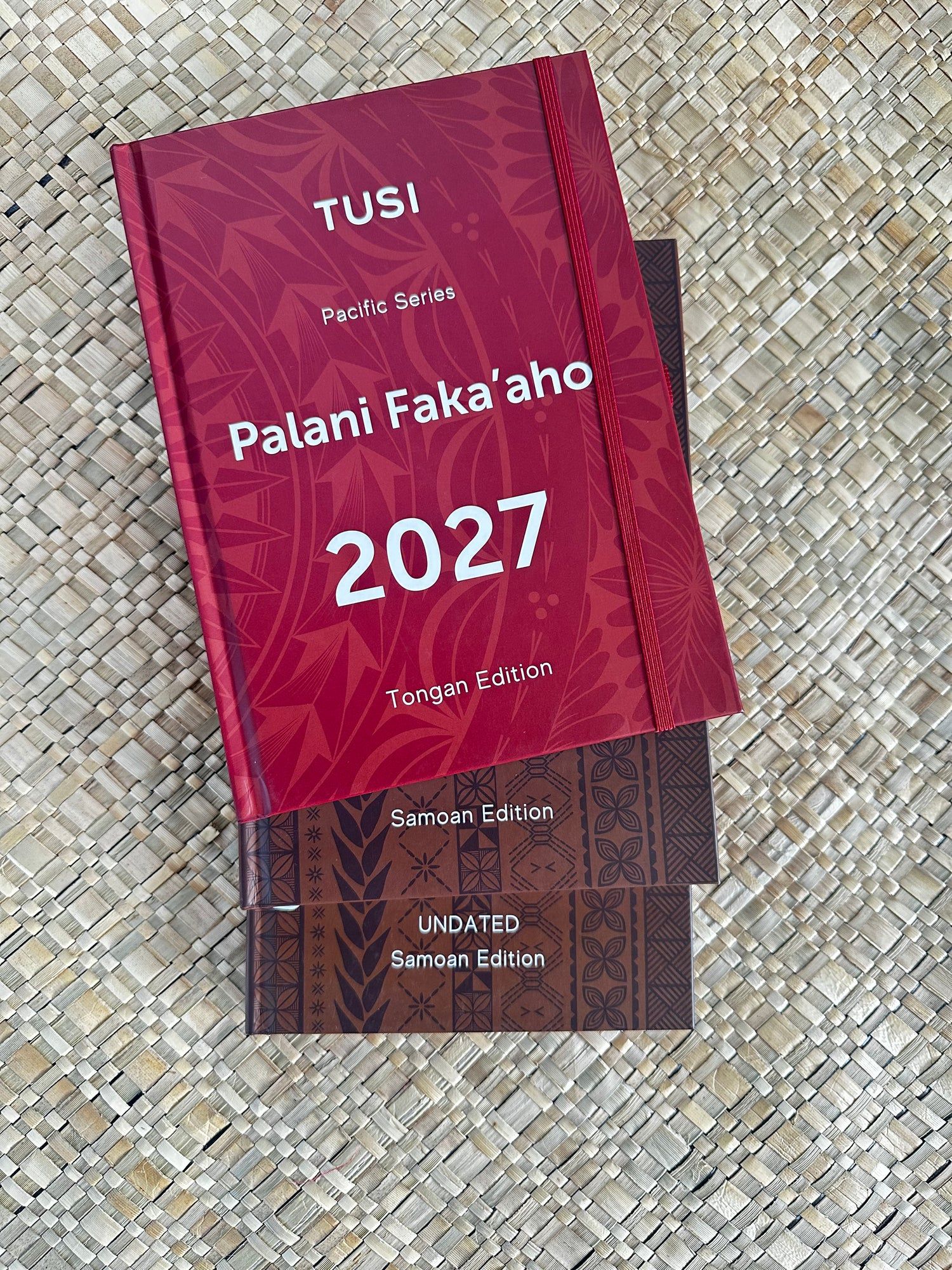
TUSI’s Palani Faka’aho is a Tongan bilingual diary featuring lotu, hiva, phrases, greetings and artwork, designed to support people on their Lea Faka-Tonga journey. Photo/Supplied
The push to keep Tongan language alive is also being seen through music.
For Tongan singer Folau, Tongan Language Week has given him a chance to release his first song, written completely in Lea Faka-Tonga, Mamahi Moe Kona.
Folau earlier said the loss of his grandparents inspired the song as he struggled to put his grief into words.
“What I know now in terms of wisdom and knowledge, I wouldn't have learned what I know if it wasn't for them.
“That’s what makes this Tongan Language Week special for me because this is my first song that I've written in my own mother tongue in the Lea Faka-Tonga.”

Tongan singer Folau has released his first song written entirely in Lea Faka-Tonga, Mamahi Moe Kona, inspired by the loss of his grandparents. Photo/Supplied
Language is also being carried into classrooms far from Tonga.
Amelia Tuionetoa Connor, a teacher at the British Cambridge International School in Malaysia, uses bilingual resources and storytelling to bring te reo Māori and Lea Faka-Tonga into her Year Five classroom.
Connor moved to Malaysia with her family in June last year. She says her students from Japan and China are curious about her Tongan background.
“I have students from China and Japan, and they are fascinated when I explain to them I was born and raised in Tonga. This is my language, and my kids went to a Tongan school in New Zealand,” Connor said in a statement.
Connor grew up speaking Tongan but says finding time to speak the language with her own family can be difficult.
“I've been very slack with that, there's such limited time in a day to speak to your kids, especially when they're at school,” she says.
Watch Folau's full interview below.
The 2023 New Zealand Census recorded 97,824 identifying as part of the Tongan ethnic group, up 82,389 in 2018 and 60,333 in 2013.
About 37,752 people from the Tongan ethnic group speak the language, making Lea Faka-Tonga the second-most spoken Pacific language in New Zealand.
For Pacific communities, the work of keeping language alive is happening in everyday places - in homes, schools, music and even the pages of a diary.
It is about making sure language remains something people use, share and pass on, rather than something that belongs only to the past.
Cedric Tausinga, a journalism student at AUT, is currently completing a two-week internship at PMN News.