‘Soul resuscitation’: Pioneering Vagahau Niue and cultural connection down South
Atutahi Potaka-DewesFri, 23 Oct

From left: Pacific Peoples Minister Paul Goldsmith, Labour deputy leader Carmel Sepuloni and Green Party MP Teanau Tuiono each outlined how their parties would tackle the cost of living after PMN's Pacific election survey identified it as the top issue for Pacific voters.
Photo/Supplied/PMN composite
The Pacific Peoples Minister says National must spend more time listening to Pasifika communities after PMN's election survey found most respondents do not believe the party understands them.



Pacific Peoples Minister Paul Goldsmith has acknowledged National has "more work to do" to connect with Pacific communities after PMN's Pacific election survey found most respondents do not believe the party understands their concerns.
Speaking with William Terite on PMN's Pacific Mornings on Wednesday, Goldsmith became the first senior National minister to respond to the findings of the PMN/Horizon Research Pacific Issues Election Survey, released last week.
The survey found 72 per cent of Pacific respondents believe National does not understand Pacific communities well.
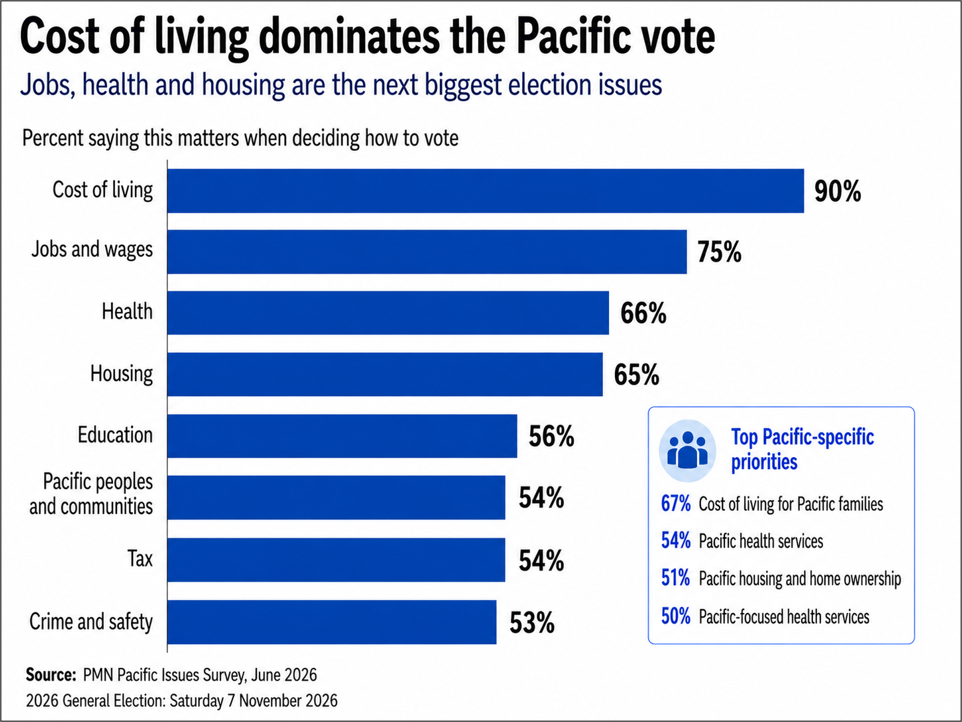
It also showed the cost of living emerged as the biggest issue facing Pacific families, with nine in 10 respondents saying it will influence how they vote in November.
Asked about National's standing with Pacific voters, Goldsmith said the findings showed the party needed to keep engaging with communities.
"I don't know about the details of how many people the poll covered and how it operated but yes, obviously it indicates that we've got more work to do to get out and about amongst Pacific communities and listen and we certainly strive to do that on a regular basis."
Watch Paul Goldsmith's full interview below.
The survey also found Labour attracting 50 per cent of the Pacific party vote, compared with 11 per cent for National and the Greens and seven per cent for NZ First.
Goldsmith said National wanted to improve that result. "We would like to do better than that, obviously. Every party vote counts."
Goldsmith instead pointed to the Government's wider economic programme, arguing reforms aimed at lowering costs would ultimately benefit households struggling with everyday expenses.
He argued that reforms aimed at lowering costs would ultimately benefit households struggling with everyday expenses.
He said the Government's Resource Management Act reforms would help reduce the cost of building homes, supermarkets and other developments. "Everything is more expensive than it needs to be."
Goldsmith also defended the Government's handling of inflation, saying higher fuel prices linked to the conflict in the Middle East had contributed to the latest rise.
"If you put to one side the fuel costs caused by the conflict in the Middle East, we would be under three per cent and interest rates have come down."
He urged Pacific voters to stick with the coalition. "My simple message is if you want to stay on this track where we're having lower inflation, lower interest rates, more money in your pocket, then stick with this current government."
Watch Carmel Sepuloni's full interview below.
Labour deputy leader Carmel Sepuloni told Terite the survey reflected what she was hearing from Pacific communities.
She said the Government was "completely out of touch" and argued Pacific families were continuing to struggle with rising costs.
Sepuloni said Labour's response would focus on easing household pressure through measures such as three free GP visits, a weekly $20 cap on public transport in major cities and other affordability policies.
"There's no one policy that's going to completely alleviate all of the pressures that come with the costs that people are experiencing. But every policy... really do make a difference."
Green Party MP Teanau Tuiono also linked his party's response to the cost-of-living pressures identified in the PMN survey.
He promoted the Greens' proposed Kiwi Power plan, saying it would lower electricity bills by investing in publicly owned renewable energy and community energy projects.
Listen to Teanau Tuiono's full interview below.
"Well, it'll bring down power bills," Tuiono told Terite. "I mean, that's the main driver of it... bring down the power bills, make things more energy efficient, and actually have a plan for the future here as well."
Tuiono said reducing households' reliance on fossil fuels would also help shield families from overseas shocks affecting fuel and energy prices.
"What we're seeing around the world, in particular with the war in Iran, is that there is an energy crisis, energy shortages."
He said the Greens wanted greater investment in renewable energy, including hydro, geothermal, wind and solar power, alongside zero-interest loans to help households install rooftop solar systems.
When asked about the Government's response to rising inflation, Tuiono accused National of failing to prepare New Zealand for economic challenges. "That's just the shifting blame game."
The survey found the cost of living remains the dominant issue for Pacific voters, ahead of jobs and wages, health and housing.
While the Government and opposition parties disagree on how to tackle those pressures, Wednesday's interviews showed National, Labour and the Greens see affordability as the defining issue for Pacific communities heading into the 7 November electiony, although each party is proposing a different approach.
The PMN News-Horizon Research Pacific Issues Election Survey was conducted online between 23 June and 7 July 2026. It surveyed 293 respondents and the sample was weighted on age and gender for Pacific peoples 18 years of age or over, based on the 2023 Census. The survey has a maximum margin of error of ±5.7% overall.
This survey complies with the political polling code of the Research Association of New Zealand, of which Horizon Research is a member.