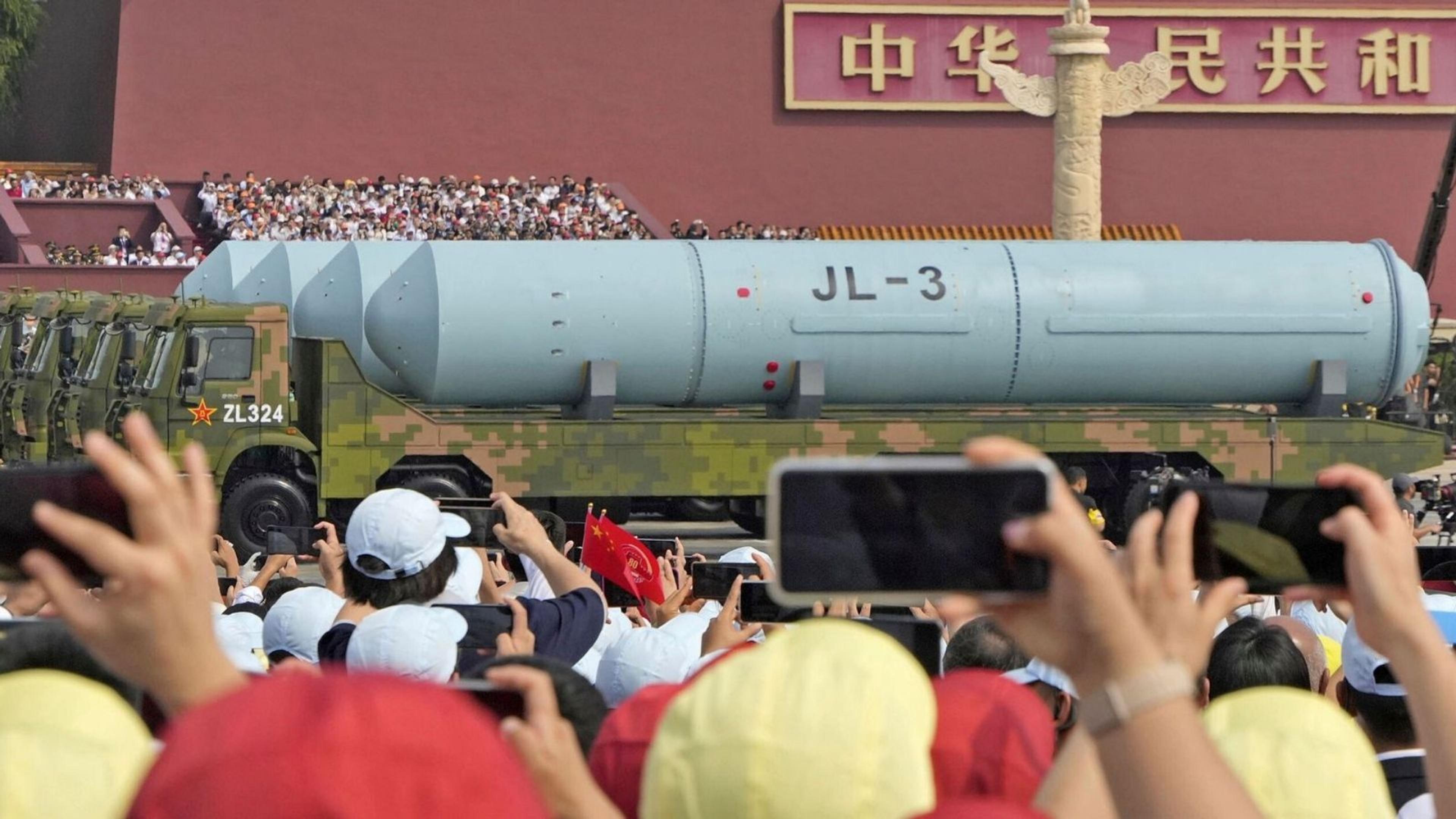
China's long-range ballistic missile test into the South Pacific has renewed debate over regional security, with experts divided on how Pacific nations should respond as geopolitical competition intensifies.
Photo/SkyNews/screengrab
Pacific Region
China missile test sparks debate over Pacific security and what comes next
The experts say the bigger question is not what happened on Monday, it's how countries respond without losing sight of their own priorities.

Christine Rovoi
Published
07 July 2026, 10:33am
Share
Copy Link

China's long-range ballistic missile test into the Pacific this week has exposed sharply different views on how the region should respond.
Some say the launch demands a stronger response while others warn against overreacting as geopolitical competition intensifies across the region.
The debate comes as Australian Prime Minister Anthony Albanese visits Solomon Islands on Tuesday for its Independence Day celebrations after signing a new defence agreement with Fiji on Monday, highlighting Canberra's renewed focus on Pacific security.
While New Zealand and Australia have condemned the launch, three experts told William Terite on Pacific Mornings the bigger question is what the island nations do next.
International law expert Professor Al Gillespie believes the launch marks a serious moment for the region.
"It's very significant," he said. "It undermines the idea that we're an area of peace and sustainability."
Although he said China's actions were not illegal under international law if the missile travelled through international airspace and landed in international waters, Gillespie said legality was only part of the issue.
"Fundamentally what they did was not illegal. However, it was not friendly either."
Gillespie said the launch should encourage Pacific countries to think beyond diplomatic protests and push for stronger regional rules.
Listen to Al Gillepie's full interview below.
"If we don't want it, the next step is what law do you add to prohibit it?"
He suggested strengthening the South Pacific's nuclear-free arrangements by adding a ban on missile testing by all countries, not just China.
"It can't just be China that can't test missiles in the Pacific. It would also be the United States."
Defence analyst John Battersby agreed the launch was a clear show of China's growing military reach but warned against treating it as an unexpected turning point.
"I think we probably need to stand back and not have an immediate reaction," he said. "It's not the first time that they've done a missile test in this area."
Instead, Battersby said the launch was another reminder that the Pacific security environment is changing.
Listen to John Battersby's full interview below.
"This is just another example of how it's doing it. We've had live firing exercises. We've had a missile test. So to a certain extent, this is the new normal."
Even so, he believes New Zealand and its partners cannot ignore what is happening.
"The world is not the way it was in the late 20th century. We're in a new world now and we do need to wake up to it."
For Associate Professor Gordon Nanau from the University of Auckland, however, the biggest risk is that discussions about missiles, military partnerships and strategic competition overshadow the concerns of Pacific people themselves.
While regional leaders continue to navigate growing competition between major powers, he said everyday life remains the priority for most people across the islands.
"I think many people I would say in the Pacific hear about these geopolitical discussions. But for them, what is actually happening on the ground or the tangible things that affect their lives on the ground is much more important and critical to them."
Watch Gordon Nanau's full interview below.
Nanau said Pacific countries have consistently made it clear they do not want their region caught between competing global powers.
"I think we do not want the Pacific to be a battleground for other interests."
Instead, he said leaders should focus on strengthening regional cooperation and ensuring Pacific voices remain at the centre of decisions that affect the region.
"The important question to be asking is how do Pacific Islanders feel about this? I think that's to me is a more critical discussion and a more critical question to be asking."
China has defended the launch, saying the missile travelled through international airspace and landed in international waters, in line with international law.
Beijing also said it gave advance notice to countries along the flight path and described the test as routine military training that was not aimed at any specific country.
Chinese officials have argued that modernising the country's strategic capabilities is a defensive measure and not a threat to Pacific nations.
The United States has also raised concerns over the launch, saying it was a test of an unarmed intercontinental-range ballistic missile launched from a submarine.
Washington said China's growing nuclear capabilities were a concern for the region and called on Beijing to engage in arms control discussions and commit to regular notification arrangements for future launches.
But as governments weigh their next moves, the interviews with Al Gillepie, John Battersby and Gordon Nanau highlight a broader question facing the region: how Pacific nations can protect their security without allowing outside powers to define the region's future or overshadow the priorities of the people who call it home.