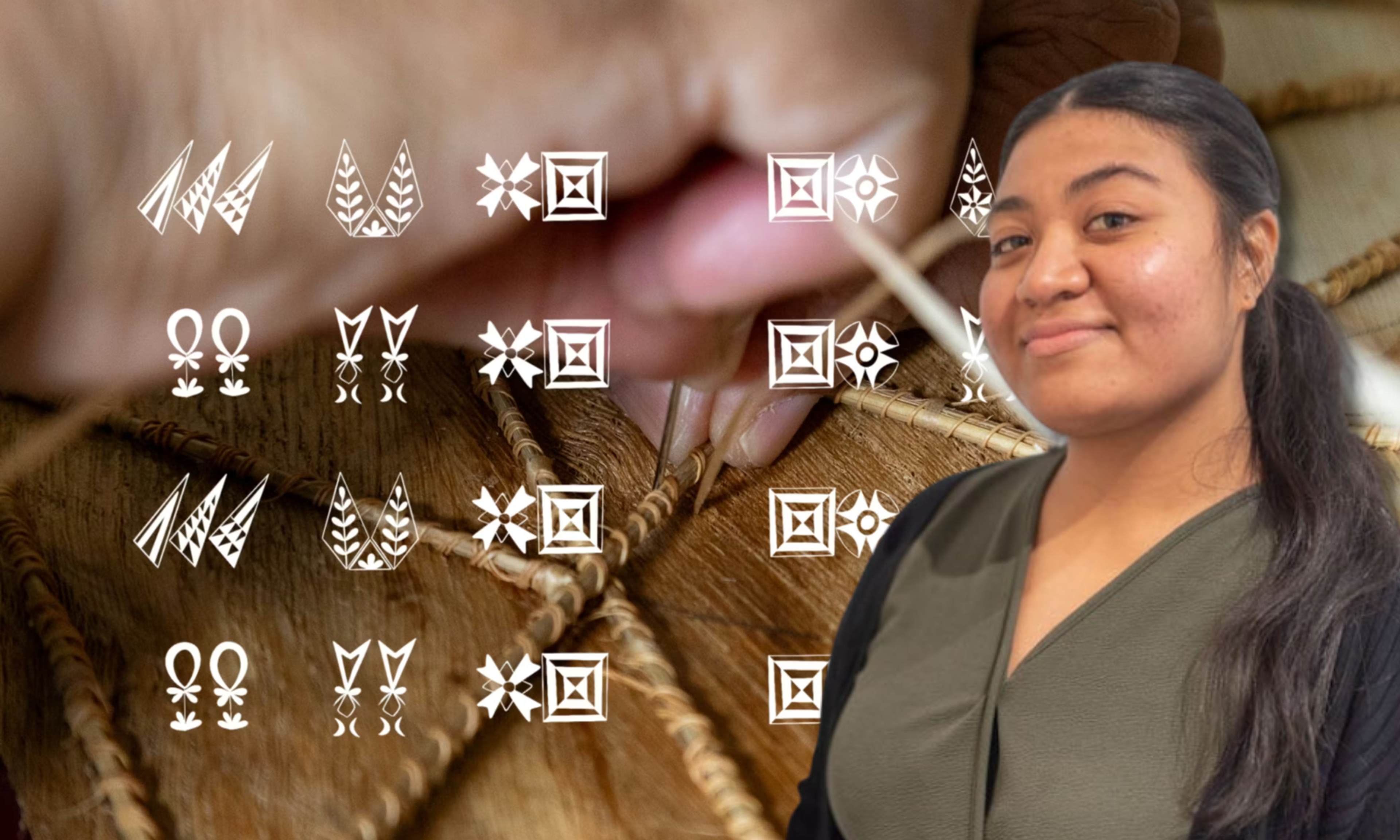
'Uhila Moe Langi Nai utilised locally sourced natural materials from Tonga in her latest exhibition at Te Wai Ngutu Kākā Gallery.
Photo/PMN Composite
Arts
Weaving Memory: Tongan tapa comes alive in Auckland
Ngatu artist and PhD graduate ‘Uhila Nai revives ancient ngatu and kupesi techniques, and contemporary artistry.

Atutahi Potaka-Dewes
Published
16 March 2026, 3:46pm
Share
Copy Link
Top stories

Solar power could bring safer water to 23 more remote communities
Christine RovoiWed, 30 Sep
US welcomes Naoero withdrawal from international court
Christine RovoiWed, 30 Sep
Top stories
Solar power could bring safer water to 23 more remote communities
Christine RovoiWed, 30 Sep
US welcomes Naoero withdrawal from international court
Christine RovoiWed, 30 Sep
Stretching 26 metres across the gallery, ‘Uhila Moe Langi Nai’s latest exhibition turns ancient Tongan barkcloth into a living tapestry of memory, heritage, and skill.
Marking the completion of her PhD in Visual Arts at Auckland University of Technology (AUT), Nai produced Tohi Kumi Koloa - Ko e tohi fepōtalanoa‘aki pea mo ‘eku fanga kui - a work that honours the techniques and traditions passed down through generations.
She travelled to Tonga for concentrated periods to dive into ngatu (barkcloth) and kupesi (embroidered relief stencil) making, sourcing distinct natural fibres and materials.
“Everything that I use across my practice, it comes from her,” Nai says of her grandmother, Nena, whose teachings shaped her work, during an interview on PMN Tonga. “It draws from her.
“Even though she has now passed. She's somewhat still…it feels like she's still alive within my practice.”
Nai’s practice explores the Tongan concept of heliaki - the art of metaphorical double speaking. For Nai, kupesi functions as a visual heliaki.
Watch 'Uhila Moe Langi Nai's full interview below.
It led her to investigate ancestral wisdom embedded into the designs and examine her own relationship with skilled masters.
“The research was looking at the idea of how I can continue the tradition,” Nai says. “How can I pass on a practice that has been lived, or it has been a part of our life as the women of Tonga?”
Her research honours the kupesi heritage of Pelehake village while also drawing from her ties to Tatakamotonga, Fua’amotu, and the islands of Foa and Nomuka in Ha’apa.
“Taking something from Tonga, bringing it to New Zealand in an academic system was a bit of a challenge, going between those two spaces,” she says.
“Going back to Tonga and coming back to New Zealand, the majority of the time, that really helps me [stay] grounded. Being able to bring that tradition or knowledge over to a space that we don't talk about a lot.”
Nai breaks down the name Tohi Kumi Koloa:
Tohi - the knowledge handed down.
Kumi - the research personified through Nai reconnecting with her history.
Koloa - the end product.
For Nai, the evolution of ngatu faces a critical hurdle with the rise of machine-made techniques and synthetic materials.
She says it is important to retain traditional knowledge to understand how natural materials, dyes, and fibres “react” with each other.
Nai also emphasises the communal aspect of the practice.
“Tohi Kumi Koloa is about me passing on and continuing this specific knowledge that has been passed on to me and creating an end product, creating a ngatu or specific textile as a gift back to the community.
“Not just about my grandma…ngatu is about women. Getting together, sharing conversation and passing on that knowledge.”
Tohi Kumi Koloa - Ko e tohi fepōtalanoa‘aki pea mo ‘eku fanga kui by 'Uhila Nai is on display at Te Wai Ngutu Kākā Gallery until 20 March.