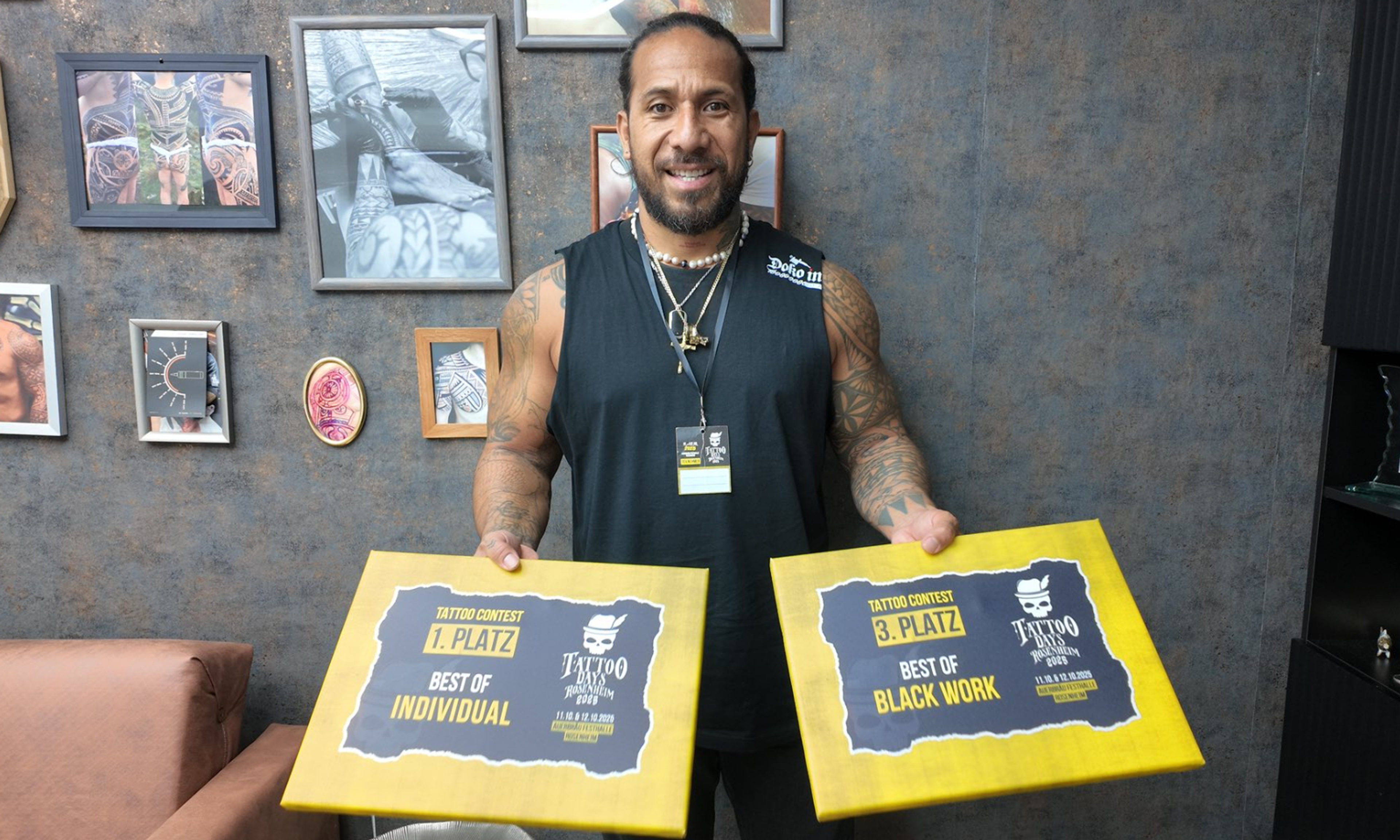
Mana Fifita and his tattoo studio Doko Ink was recognised at a tattoo convention in Germany in 2025.
Photo/Facebook
Arts
Inked across lands: How Pacific tattoo art is thriving in Germany
Doko Ink brings Polynesian markings to Europe, sparks fascination and tough questions about cultural sovereignty.

Atutahi Potaka-Dewes
Published
18 February 2026, 4:39pm
Share
Copy Link
Top stories
Top stories
In the Bavarian town of Erding, Germany, famous for its historic breweries and thermal spas, an unexpected cultural exchange is taking place.
Mana Fifita, a Tongan tattoo artist trained in Aotearoa New Zealand, has established Doko Ink, a studio dedicated to Polynesian tattoo patterns.
His move to Europe highlights a growing global demand for Pacific iconography while raising questions about practising indigenous art far from its cultural roots.
Fifita’s journey began in 2008 when he left Tonga for Aotearoa. Facing language barriers and a lack of traditional work skills, he found his calling under the mentorship of renowned Tongan tattooist Carl Cocker.
Today, Fifita works mostly with non-Pacific clientele in Germany, helping people translate their personal stories into the symbolic language of Polynesian patterns.
“It’s my job to pick out what is the best connection,” Fifita says on PMN Tonga. “Their story with our pattern. All our patterns, there’s meaning behind [them]. Māori tattoo, Marquesan, or Fijian, pick from them and kind of combine them together and create a piece for this person.
Watch Mana Fifita's full interview below.
Europe’s growing Polynesian tattoo scene
Fifita says Germany is emerging as a major market for Polynesian-style tattooing. Many clients are drawn to the “warrior” identity associated with Pacific cultures and seek full-body compositions.
His presence has also reshaped the local landscape.
“The purpose is to showcase our true art,” Fifita says. “Because most of the artists here, they call themselves a ‘Polynesian tattoo artist’, but they are not Polynesian. They are European, they’re doing our art.”.
“When I turn up they often shake my hand, they recognise we’re here. They never want to challenge, but they come and ask for help…whoever doesn’t know me, they will go to people like this.”
Cultural ownership and the global spread of tātatau/tatau/tāmoko
The global spread of these art forms is not without tension. The “Tongan malu” controversy, where the Tongan motifs were applied in a Sāmoan tatau, sparked debate about cultural sovereignty.
Some argue the shared histories of Tonga and Sāmoa allow for exchange, while others insist certain designs are “closed” rites whose spiritual integrity can be compromised if misused.
Aotearoa provides a parallel: the distinction between tāmoko (traditional Māori tattooing) and kirituhi (‘skin art’ designed for non-Māori) is a vital safeguard for Māori intellectual property and spiritual tapu.
In a social media post, Māori moko and digital artist Te Haunui Tuna stresses the depth of whakapapa connection in tāmoko.
“I don’t think they should be doing it,” Tuna says. “Because…moko isn’t just the aesthetic or visual aspect of it. It’s also the kōrero of the designs, it’s about the connection that kōrero has to this whenua.
“It’s a bit of a responsibility to put moko on people, you need to understand all those things, and people who are not Māori or who weren’t taught to do it properly, shouldn’t be doing it.”
For Fifita, the challenge is balancing respect for cultural protocols with the opportunities of a global market. His studio is a space where Pacific tattoo traditions are preserved, shared, and adapted with integrity, offering Europeans a window into the depth and meaning of Polynesian art.