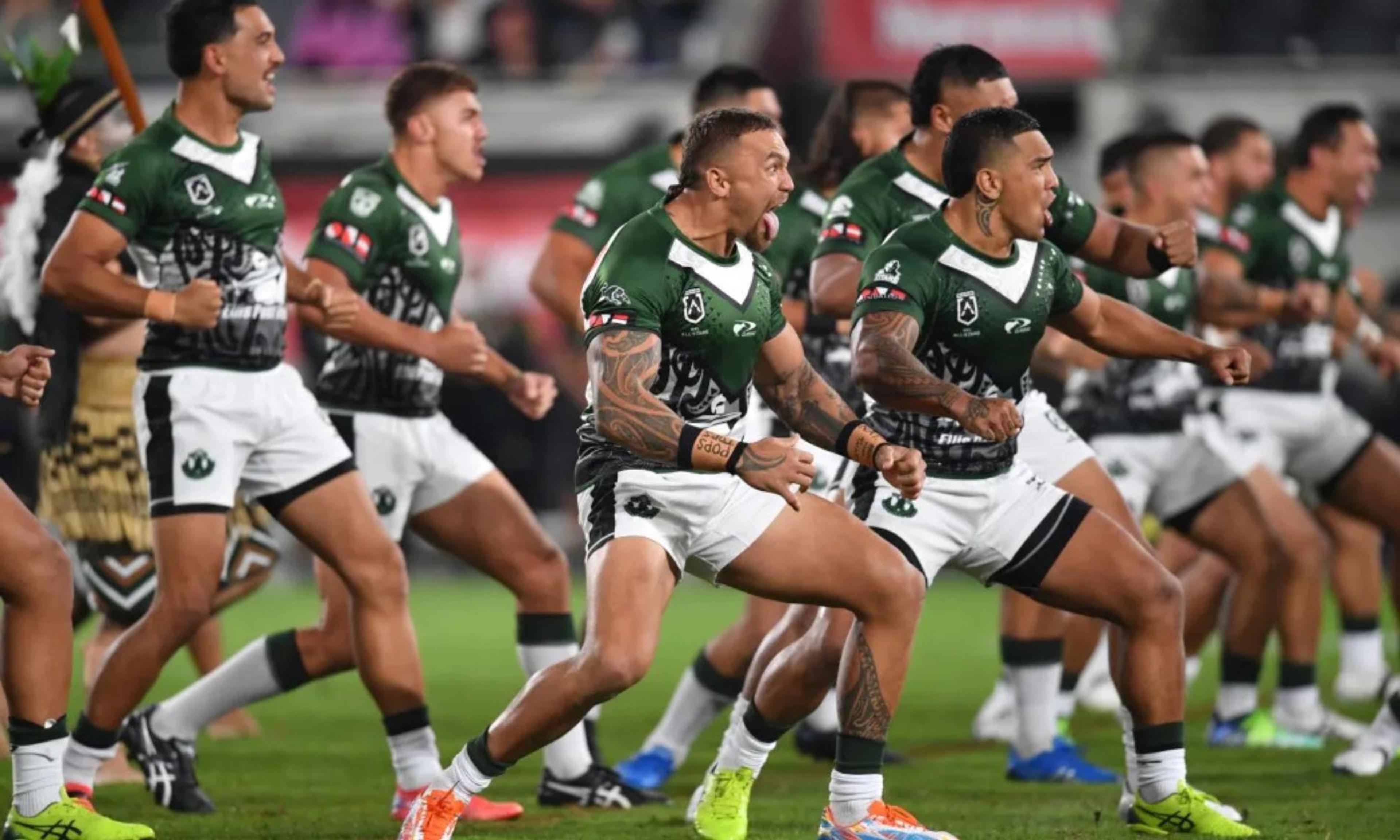
Indigenous All Stars players perform a powerful pre-match haka-style challenge, centring culture and identity ahead of their clash with the New Zealand Māori side.
Photo/NRL
Sports
Time for an Indigenous State of Origin? The All Stars game shows who really powers the NRL
Fifteen years after it began, the Indigenous All Stars clash with the New Zealand Māori sides has become more than a season opener.
Hoani Smith, Dion Enari, and Phil Borrell, of The Conversation
Published
15 February 2026, 12:22am
Share
Copy Link
Top stories

Top stories
Analysis - This weekend's National Rugby League clash between the Indigenous All Stars and the New Zealand Māori men's and women's sides marks a decade-and-a-half of recognising a unique aspect of the trans-Tasman game.
First staged in 2010, the season-opening fixture was not conceived as a marketing stunt, but as a deliberate exercise in showcasing Indigenous excellence and its contribution to the competition.
The match centres Aboriginal and Torres Strait Islander players, and their culture and leadership at the highest level of the game. The rationale was clear from the outset: Indigenous Australians were - and remain - significantly over-represented relative to their share of the national population.
In 2010, the NRL reported that more than 12 percent of its playing group identified as Aboriginal or Torres Strait Islander, despite Indigenous Australians making up less than 3 percent of the population.
More recent estimates suggest that proportion has increased, now sitting closer to 15 percent across the men's and women's NRL games, while accounting for less than 4 percent of the general population.
But what began as recognition of that over-representation has since evolved into something more relational, collective and trans-Tasman. It now reflects broader Indigenous leadership traditions in elite sport that prioritise whakapapa (genealogy), collective responsibility and cultural authority.
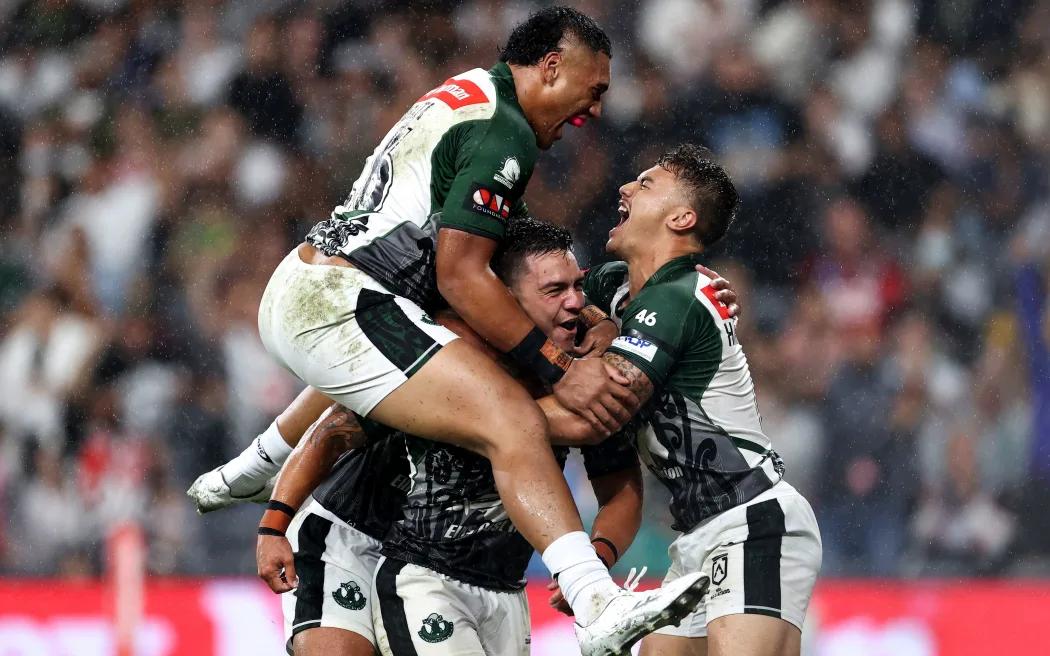
Māori All Stars celebrate a try in emotional scenes, underlining the pride and unity that define the annual trans-Tasman contest. Photo/Photosport
Women players on the rise
A major turning point came in 2019 when the Indigenous All Stars first played the New Zealand Māori team instead of an NRL or world side. This reframed the fixture as an Indigenous-to-Indigenous contest across the Tasman, rather than simply an Australian brand.
While the men's Indigenous All Stars match began as the centrepiece, the women's fixture has become one of the event's most structurally important expressions, reflecting the rapid growth of the National Women's Rugby League (NRLW).
Demographic patterns in the women's game are particularly pronounced, with NRL inclusion data showing roughly 48 percent of NRLW players identify as Māori or Pasifika, with a further 14 percent identifying as Aboriginal or Torres Strait Islander.
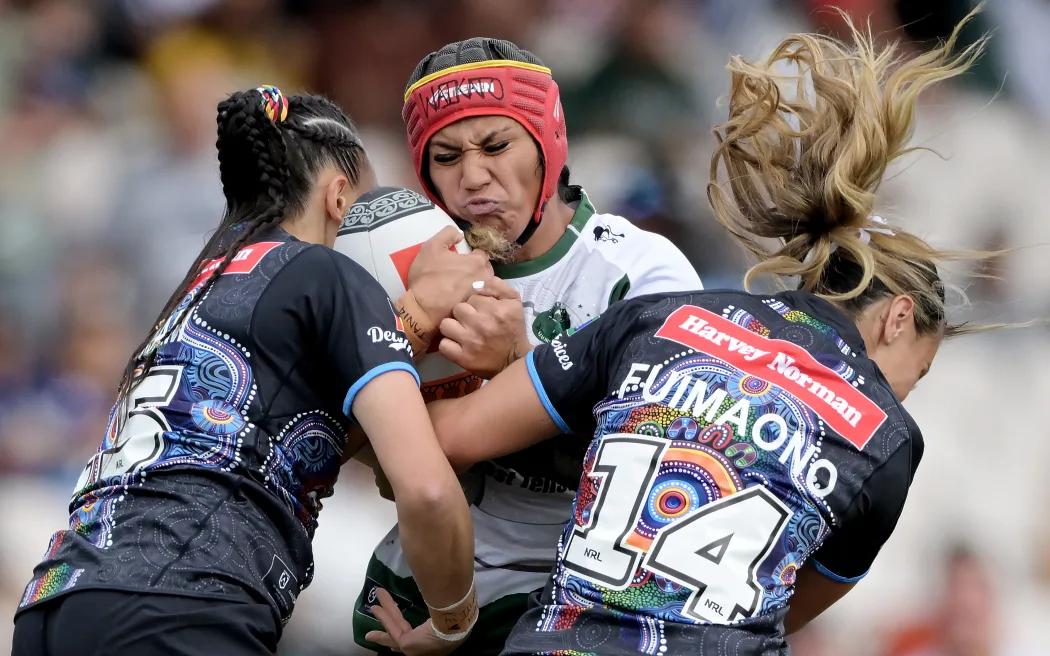
Players drive into contact during the women’s fixture, highlighting the strength and rapid growth of the NRLW showcase. Photo/Photosport/Kerry Marshall
These figures show the women's Indigenous All Stars team is not an add-on. It functions as a legitimate pathway, leadership platform and cultural anchor for a competition whose future growth depends heavily on Indigenous and Pasifika participation and whānau (family) engagement.
Within the NRL, Māori players are typically counted within broader Polynesian or Pasifika demographic categories. Recent analyses suggest Polynesian players now account for close to, and potentially more than, 50 percent of the top tier of NRL contracts.
Māori comprise about 17 percent of the overall New Zealand population, and Pasifika peoples make up a further 8 percent. On NRL rosters, those proportions are largely inverted.
Combined with those identifying as having Indigenous Australian or Torres Strait Islander heritage, a clear majority - around 62 percent - of NRL players now come from Indigenous Australian/Torres Strait Islander, Māori and Pasifika backgrounds.
An Indigenous State of Origin?
As Indigenous sport researchers and practitioners, we work to highlight the importance of culture to professional rugby league.
That 62 percent of players also represents a huge, vibrant fan base. Collectively, this Indigenous influence is the opposite of the cultural tokenism that can be found in many Eurocentric sports systems.
The unprecedented success of last year's NRL Pacific Championships, particularly the extraordinary match between Samoa and Tonga, further illustrated this shift.
With the disproportionate number of Pacific athletes who make the NRL the spectacle it is, perhaps it's time for the sport's gatekeepers to consider a three-game series, modelled on State of Origin.
This would bring together Māori, Pacific and Indigenous all-star sides. With players clearly expressing their pride in the All Stars game, it would be a fitting showcase.
The success of the Pacific Championships suggests there is also potential for including Māori and Indigenous Australian teams in an extended format that would better reflect the cultural and playing realities of the modern game.
Both would offer a competitively legitimate platform for this key group of rugby league superstars, and would meaningfully recognise their long-term cultural and commercial value to the game.
* Hoani Smith is a Lecturer in Sport Management and Sport Science, Lincoln University, New Zealand; Dion Enari is an Associate Professor, Ngā Wai a Te Tūī (Māori and Indigenous Research Centre) and School of Healthcare and Social Practice, UNITEC Institute of Technology; Phil Borell is Senior Lecturer (Above the Bar), Aotahi School of Māori and Indigenous Studies, University of Canterbury
- This story originally appeared on The Conversation.