Tuvalu climate minister says Pacific aid means little as Australia backs fossil fuels expansion
Christine RovoiTue, 22 Sep
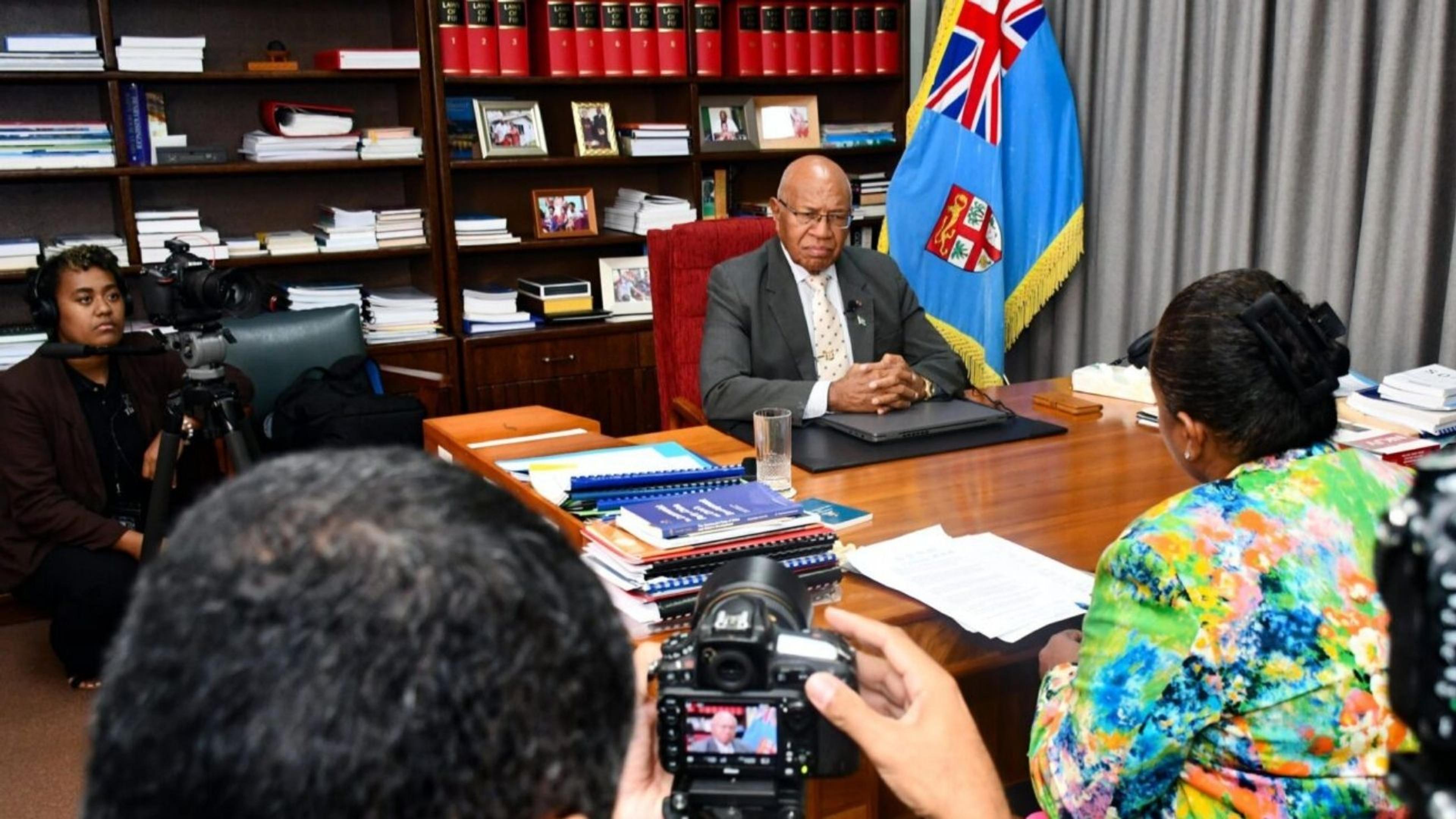
Local journalists in Fiji interview Prime Minister Sitiveni Rabuka in his office. The engagement reflects the growing focus on accountability reporting across the Pacific, as new regional support is rolled out to strengthen investigative journalism on governance and public spending.
Photo/The Fiji Times
A partnership has been launched to fund and support investigative journalists across the Pacific to strengthen reporting on corruption, illicit finance, and abuse of public money.



A major new push to strengthen investigative journalism across the Pacific has been launched with international funding and training aimed at helping reporters uncover corruption and illicit financial flows.
The United Nations Office on Drugs and Crime (UNODC) signed a partnership with the Pacific Islands News Association (PINA) in Suva on Wednesday to launch the Journalism for Pacific Anti-Corruption and Transparency (J-PACT) project.
The programme is backed by the New Zealand Ministry of Foreign Affairs and Trade (MFAT) and will run from June 2026 to March 2027.
It will provide funding, technical support, and legal training to journalists working on corruption and accountability stories across the region.
The aim is to strengthen investigative reporting on issues such as bribery, corporate wrongdoing, and the misuse of public funds while improving safety and collaboration between journalists working in different Pacific countries.
The launch comes at a time when reporters in some Pacific countries face political pressure and limited resources for long-term investigations.
In a statement, PINA boss Kalafi Moala said independent journalism played a key role in holding power to account.
“Media has a critical role to play as a watchdog to hold leaders and institutions accountable," he said.
"This project provides our journalists with the necessary capacity and regional networks to safely and effectively investigate corruption issues affecting our communities.”

PINA leader Kalafi Moala says investigative journalism plays a critical role in holding leaders and institutions to account, and that the new J-PACT programme will help strengthen the skills and regional support needed for that work across the Pacific. Photo/Supplied
The initiative will expand the Pacific Anti-Corruption Journalists Network (PACJN), allowing reporters across the region to share information more securely and collaborate on cross-border investigations.
Journalists working on cases in one country will be able to connect with colleagues elsewhere in the Pacific to verify data and track financial links that may stretch across borders.
The UN says the programme is designed to strengthen accountability by improving the quality and reach of investigative reporting.
Marie Cauchois, UNODC Regional Representative for the Pacific, said at the launch that the project is aimed at supporting stronger governance in the region.
“Corruption undermines development and stability across the Pacific," she said.
"By partnering with PINA through the J-PACT initiative, we aim to strengthen the analytical and investigative skills of local media, ensuring they can actively contribute to transparency and good governance.”

UNODC Regional Representative for the Pacific Marie Cauchois says the new J-PACT project will help strengthen investigative reporting and support greater transparency and accountability across Pacific countries. Photo/Fiji govt
The project will also roll out training on following digital money trails, investigating resource extraction industries such as logging and analysing public budgets.
It includes dedicated reporting grants to help newsrooms cover the cost of long-form investigations, which are often difficult to fund locally.
Organisers say the goal is to ensure Pacific audiences have stronger access to independent reporting on how public money is managed and how decisions are made across the region.