

Speakers at the “Investor Rights as a Barrier to Climate Action” session of the Pre-COP31 in Nadi, Fiji, examined how investor-state dispute settlement could affect Pacific governments’ climate and environmental decisions.
Photo/facebook/PANG
Pacific Region
Deep sea mining could give investors a legal route to challenge climate action - experts
Pacific analysts warn trade deals, contracts and seabed mining agreements could leave governments facing costly claims if they tighten environmental rules.

Christine Rovoi
Published
08 October 2026, 2:45pm
Share
Copy Link
Top stories

Tongan wrestler eyes final shot at Olympic dream in Los Angeles
Elton Lonaratha JnrThu, 08 Oct


Sāmoa climate activist tells leaders: You now have a responsibility to act for our aiga, future
Christine RovoiThu, 08 Oct
Top stories
Tongan wrestler eyes final shot at Olympic dream in Los Angeles
Elton Lonaratha JnrThu, 08 Oct
Sāmoa climate activist tells leaders: You now have a responsibility to act for our aiga, future
Christine RovoiThu, 08 Oct
Pacific governments could face legal claims if they change environmental rules around deep sea mining, experts warn.
They say investor protections could make it harder for countries to respond to climate and environmental risks.
The warning was raised at this week's Pacific Pre-COP31 stakeholder event in Nadi, which focused on Investor-State Dispute Settlement (ISDS), a system that allows some foreign investors to bring claims against governments through private arbitration.
Adam Wolfenden, Deputy Coordinator of the Pacific Network on Globalisation (PANG), says deep sea mining is a particular concern because the industry remains untested and governments may need to change their rules as more is learned about its impacts.
“Deep sea mining is not a climate solution," he told the Investor Rights as a Barrier to Climate Action event. "It will disrupt the climate-regulating systems of the ocean, including carbon sinks.
"For an industry that is untested and under-regulated, we do not know what the regulatory changes will be, but there will be changes. That sets Investor-State Dispute Settlement (ISDS) up as the perfect vehicle, or the perfect home, for deep-sea mining,” Wolfenden said.
PANG says investor protections can enter through investment treaties, private contracts, International Seabed Authority sponsorship agreements and national deep sea mining laws.
That could leave Pacific governments exposed if they later introduce stronger environmental protections, cancel permits or place limits on extraction.
Dr Sindra Sharma, International Policy Lead at the Pacific Islands Climate Action Network (PICAN), says the issue goes beyond seabed mining and could affect governments trying to meet their climate commitments.

Dr Sindra Sharma, left, and Adam Wolfenden at a Pacific Pre-COP31 stakeholder event in Nadi, Fiji. Photo/PANG
“We see two systems that are pulling in opposite directions," she told delegates. "We have international climate litigation, and all the Pacific states have taken climate obligations to the highest courts in the world.
“On the other side, we have investment arbitration... where investors use bilateral treaties, free trade agreements and different charters, including the Energy Charter Treaty, to challenge the very measures that governments are taking.”
Sharma says the risks are growing as countries face pressure to move away from fossil fuels.
“Existing coal, oil and gas infrastructure has to immediately cease, and those regulatory acts, coal phase-out deadlines, extraction moratoriums, permit revocations, and others, are now subject to investor claims. That is where the danger comes in,” she said.
Dr Jane Kelsey, Emeritus Professor of Law at the University of Auckland, says the legal process can also make it harder for governments to know what claims they may be facing.
“Agreements and contracts can sometimes be used in offshore, private arbitration. These proceedings are not conducted like a normal court judgment. They are often conducted in secret, and sometimes the existence of a dispute is not even known,” Kelsey said at the session.
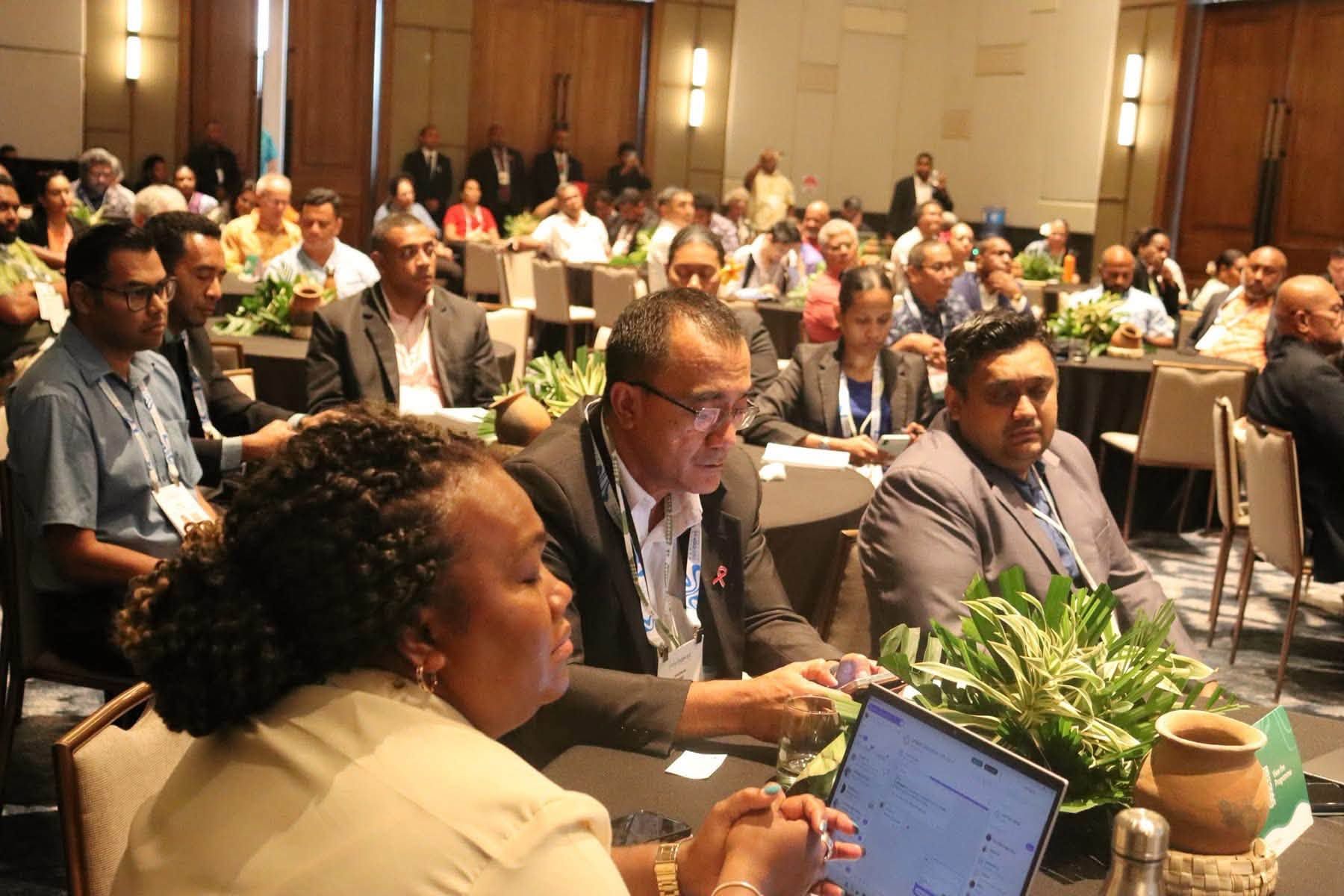
Delegates attend the Pacific Pre-COP31 stakeholder event in Fiji. Photo/Facebook/Fiji government
“That, not surprisingly, has what we call a chilling effect on government climate action.”
The warning comes as PANG highlights several ways Pacific governments could be exposed to investor-state claims linked to deep sea mining including through investment treaties, private contracts, International Seabed Authority sponsorship agreements and domestic legislation.
PANG's latest report, “Beyond Treaties: How Investment Disputes Trap Pacific Nations”, was published on 1 October. It says Pacific countries face different forms of exposure as interest in deep sea mining grows.
Dr Patricia Ranald, of the Australian Fair Trade & Investment Network (AFTINET), says Australia shows that public pressure can influence how governments approach ISDS.
Watch a media conference following day two of the Pacific Pre-COP31 Leaders event in Fiji.
But Ranald warned the mechanism is still being used by fossil fuel companies and investors seeking compensation.
“It is a real threat to democracy because they are bypassing community resistance and court decisions,” she said.
The panel called for Pacific governments to reduce their exposure to ISDS through investment agreements, private contracts and deep sea mining arrangements while pushing for stronger international action on climate change.
The Pre-COP31 discussions in Tuvalu and Fiji ended on Thursday. COP31 kicks off in Türkiye in November.