
Seymour targets office karakia as Aupito warns of a ‘culture war’
Thomas Tarurongo WynneFri, 23 Oct

There are growing concerns over online safety as reports of digital child exploitation continue to rise in New Zealand.
Photo/Nationwide Childrens
Over 20,000 reports of online child exploitation and abuse were received last year as governments and tech companies told social media platforms must be made safer by design, not just restricted by age.



Warning: This story contains references to child exploitation and online abuse.
The online dangers facing children are growing faster than efforts to protect them, according to new figures showing a sharp rise in child exploitation reports linked to New Zealand.
Data released by the Department of Internal Affairs (DIA) Te Tari Taiwhenua this week shows New Zealand enforcement agencies received more than 20,000 reports of online child exploitation and abuse from the United States-based National Center for Missing and Exploited Children in 2025.
The figure represents a 29 per cent increase from the 16,223 reports linked to Aotearoa in 2024.
Of particular concern is the rapid rise of suspected AI-generated child sexual exploitation material.
Authorities identified 151 reports involving suspected AI-generated material in 2025, up from just 21 the previous year.
New Zealand authorities say online child exploitation reports have increased sharply, with more than 20,000 cases linked to the country in 2025. Photo/RNZ/Alexander Robertson
“The sharp rise in suspected AI-generated child sexual exploitation material is of significant concern," DIA General Manager Digital Safety and Identity Investigations, Jared Mullen, said in a statement.
"While it may be artificially created, the harm it drives is real. AI-Generated child sexual exploitation material can normalise abusive behaviour and increase demand.
"This report is crucial to exposing the scale of online child exploitation,” Mullen said.

The United Nations has warned that social media platforms must be designed with stronger safeguards, not just restricted by age limits. Photo/Facebook/FBI
The figures were released as the United Nations issued a warning that governments cannot rely solely on social media bans to protect children online.
The UN Human Rights Office says many of the risks children face online are the result of deliberate platform design choices than unavoidable consequences of technology.
UN High Commissioner for Human Rights, Volker Türk, said online harms affecting children stem from business practices that prioritise engagement over safety.
“Online harms to kids' safety, privacy and wellbeing result from design choices and business practices that undermine safety including addictive design features such as infinite scroll, autoplay, and persistent notifications,” his statement read.
The warning comes as more countries consider age-based restrictions on social media. Australia introduced a ban on social media access for children under 16 in late 2025 while several other nations are weighing similar measures.
While much of the debate has centred on Australia, New Zealand and Europe, Pacific countries are also grappling with how to protect young people as internet access, smartphone use and social media engagement continue to grow across the region.
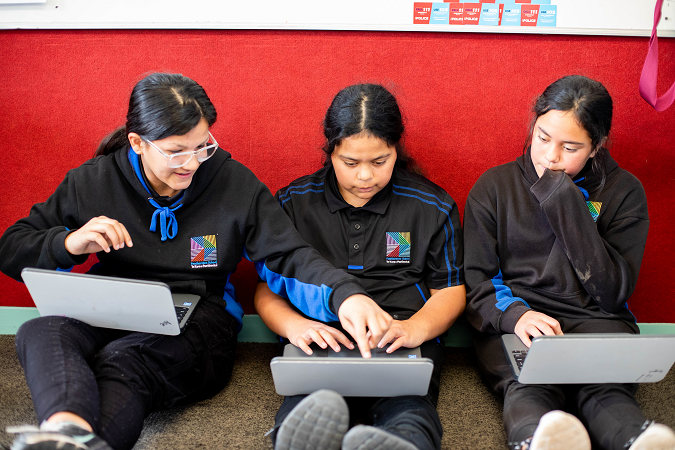
Digital safety experts say protecting children online now requires stronger action from governments, tech companies, schools and families across the Pacific region. Photo/Tāhūrangi - New Zealand Curriculum
But Türk said restricting access alone is not enough. “Simply limiting access to platforms that remain unsafe cannot stand as the endpoint,” he said.
The UN is calling for technology companies to build safety measures into platforms from the outset, strengthen privacy protections, and assess how their products affect children before they are released.
The UN's new framework also calls for mandatory child-rights impact assessments and stronger safeguards to ensure children's privacy is protected online.
The DIA report also highlights the scale of enforcement efforts in New Zealand.
Last year, authorities executed 52 search warrants, successfully prosecuted 18 offenders, safeguarded 24 children from further harm, and blocked nearly 700,000 attempts to access websites known to host child sexual exploitation material.
“Making this information public ensures New Zealanders understand the seriousness of this offending and the action underway to detect it and protect children,” Mullen said.
For Pacific families across Aotearoa and the Pacific region, the figures serve as a reminder that online safety is becoming an increasingly important issue as more children spend time on social media and digital platforms.
As artificial intelligence and digital platforms evolve at speed, authorities warn that protecting children online can no longer be left to parents and schools alone, with growing pressure on governments and technology companies to play a bigger role.
Parents and caregivers are encouraged to talk with children about staying safe online. Guidance is available at KeepItRealOnline.govt.nz.
Concerns about online harm or child exploitation can be reported to the Department of Internal Affairs Digital Child Exploitation Team, or to Police on 111 if a child is in immediate danger.
Support is available for victims of abuse through KidsHealth and Safe to Talk (0800 044 334 or text 4334).
Help is also available for people worried about their own or someone else’s sexual behaviour through Safe Network (09 377 9898), WellStop (04 566 4745) and STOP (03 353 0257).