
‘Soul resuscitation’: Pioneering Vagahau Niue and cultural connection down South
Atutahi Potaka-DewesFri, 23 Oct

Workers strike outside an ACC building in Wellington in July. Staff can now keep their flexible work-from-home arrangements after ACC’s decision to scrap extra office days.
Photo/RNZ/Samuel Rillstone
Around 300 Pasifika workers at ACC will keep their flexible work arrangements after the agency dropped plans to require more office days.




Around 300 Pasifika workers at the Accident Compensation Corporation or ACC will keep their current flexible-work arrangements after the agency dropped plans to force more staff back into the office following strong pushback from employees and the Public Service Association/Te Pūkenga Here Tikanga Mahi (PSA).
The decision is also being seen as a victory for public sector workers across New Zealand, campaigning for the right to work from home.
Many of the roughly 6.6 per cent of ACC staff who identify as Pasifika can now breathe a sigh of relief after ACC abandoned plans to require its employees to spend three days a week in the office.
The proposal, which would have increased the in-office requirement from two to three days per week, was widely opposed by staff, who argued it went against promises made in recruitment ads that offered three work-from-home (WFH) days.
"This is a clear victory for workers at ACC and for common sense, working from home is a win-win for workers and employers," Fleur Fitzsimons, National Secretary for the PSA, says in a statement.
"Our union delegates were instrumental in making sure ACC understood the depth of feeling. This win belongs to them and all the ACC staff who spoke up. ACC tried to impose this change without consultation, breaking promises made to many staff who were recruited on the basis of working from home three days a week.
"When ACC finally agreed to pause the change and consult staff on the same proposal, 80 per cent of staff opposed the change, citing impacts on well-being and work-life balance.
"We are pleased that ACC listened - that's what should happen when workers make their voices heard," Fitzsimons says.
The PSA says it had also written to the Commerce Commission seeking an investigation into ACC for breaching the Fair Trading Act.
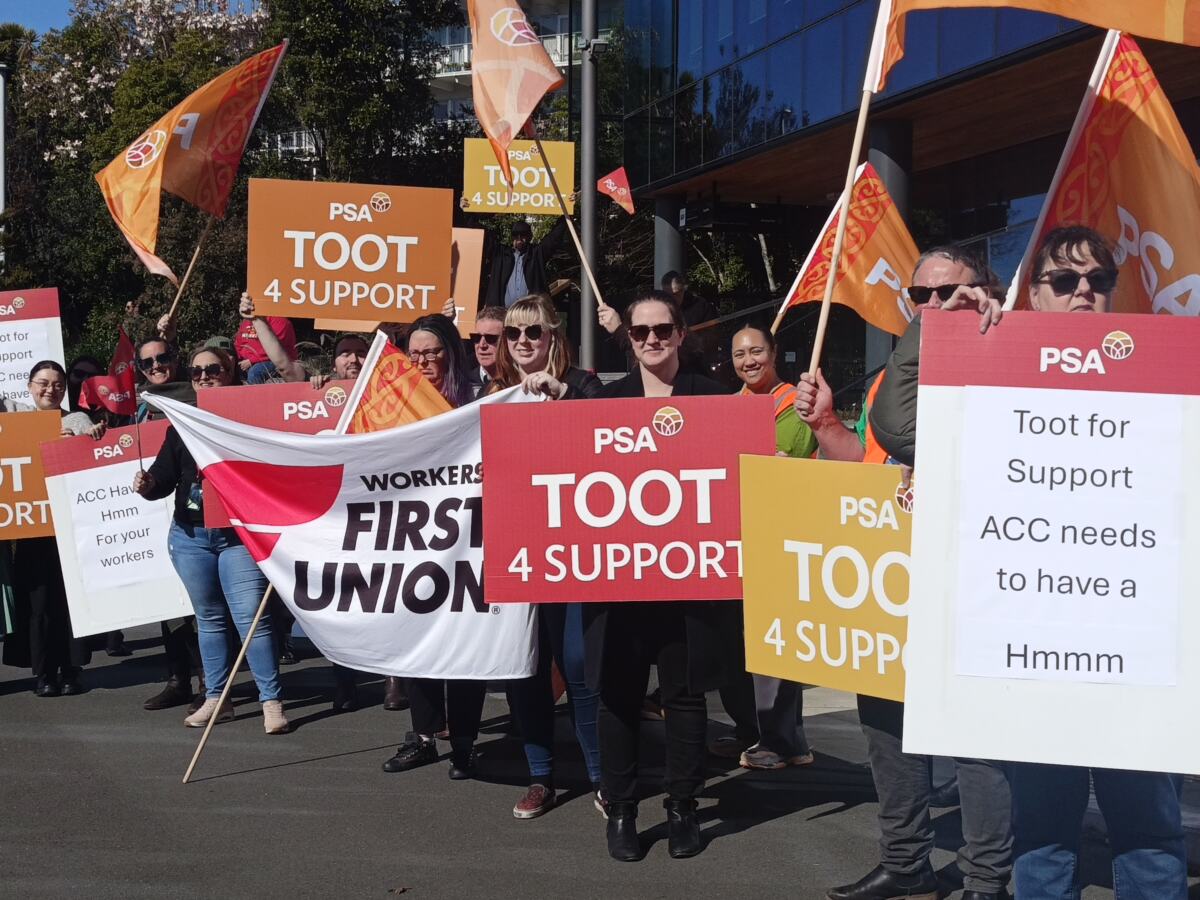
ACC workers in Hamilton held a one-hour strike in August over pay and conditions. Photo/waikatoindependent.co.nz
Megan Main, the ACC's chief executive, told RNZ that the agency had listened to employee feedback.
“We have consulted with our people on our working from home proposal and are considering their feedback. We will share the outcome of the consultation shortly.”
That outcome: the change will not go ahead. This matters for Pasifika workers, many of whom rely on the flexibility that WFH offers to balance family commitments, caregiving, and community responsibilities.
Led by the PSA, the union campaign, backed by a strong majority of staff (around 80 per cent) opposing the change, pressured ACC to rescind the plan.
"All this could have been avoided if ACC had just listened to what the recent culture review showed about staff morale and consulted from the get-go.
"We hope this decision today marks the beginning of a more constructive relationship between ACC and its workforce, where staff are respected and consulted before major changes are imposed.
"This victory sends a strong message to all workers in New Zealand. When workers through their union organise and stand firm, we win. This is crystal clear proof of that."
Lisa Hansen, ACC’s deputy chief executive for people and culture, also told RNZ that the organisation would continue to act as a good employer and respect staff rights during industrial action.
“ACC will continue to act as a good employer during this industrial action. PSA members are first and foremost our staff members. It is their right to take action, and we support their right to do so.”
For Pasifika staff, whose lives often cross cultural, family and community lines, the decision preserves more than flexibility: it preserves dignity, trust, and work-life balance.

ACC Christchurch. Photo/ACC
With ACC employing roughly 4576 people in total, and about 6.6 per cent identifying as Pasifika, the reversal affects an estimated 300 Pacific workers directly.
The outcome is also being seen as a signal for other public sector employees in New Zealand, showing that organised staff campaigns and union advocacy can protect and expand flexible working arrangements across the workforce.
Unions believe that as the PSA and ACC move forward to finalise their collective agreement, there is hope that this marks a shift toward a more inclusive, consultative workplace, one that values the needs of all staff, including those from Pasifika backgrounds.