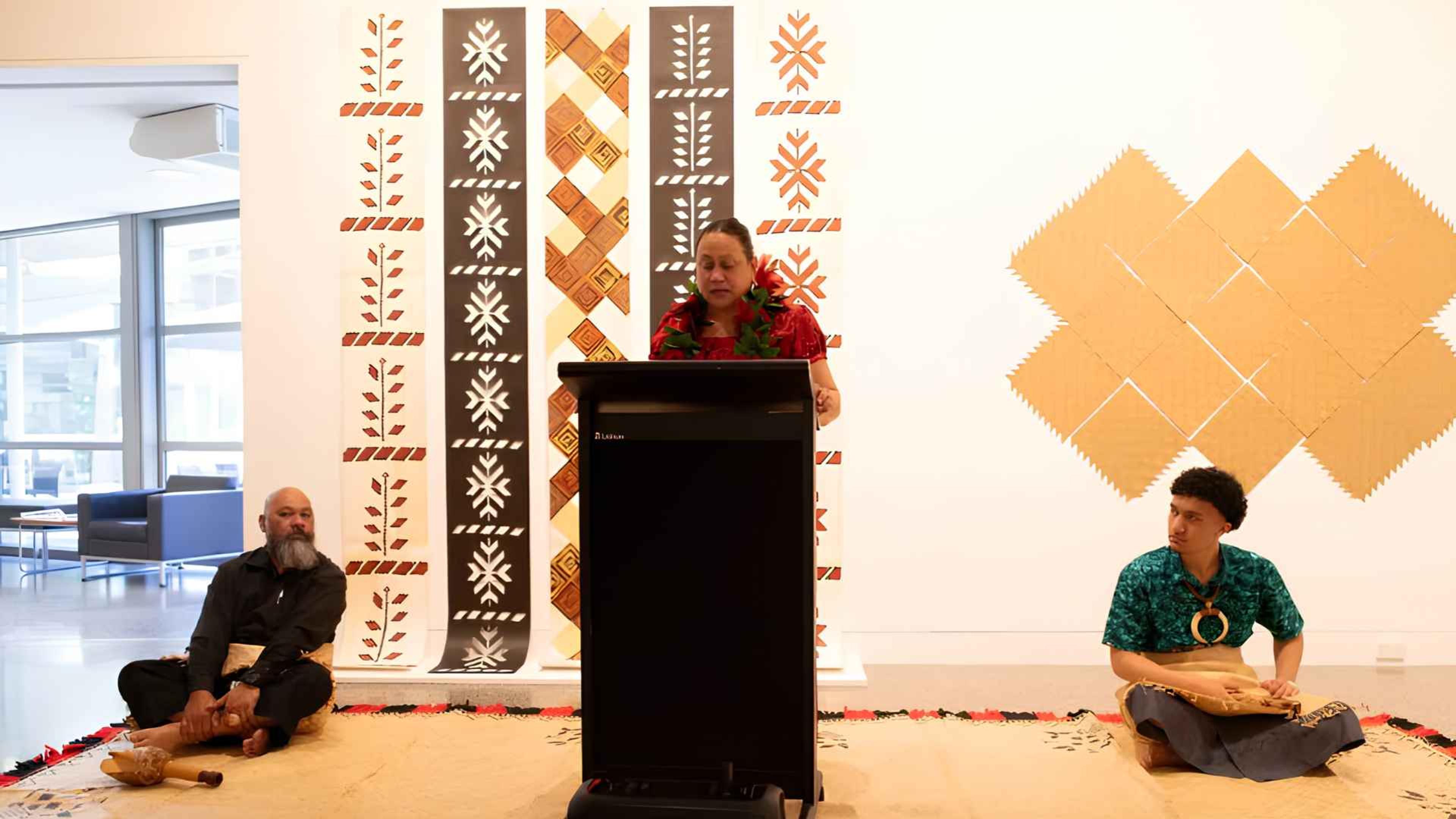
Dagmar Vaikalafi Dyck at the opening of Fatunga Falanoa: Ancestral Futures.
Photo/Instagram/Dagmar Vaikalafi Dyck
Arts
Tongan artist puts women makers and ancestral knowledge at centre of new exhibition
Dagmar Vaikalafi Dyck says her Auckland show is a tribute to wāhine whose hands, stories and knowledge shape Tonga’s culture across generations.

Aui'a Vaimaila Leatinu'u
Published
25 November 2026, 3:23pm
Share
Copy Link
Top stories

World Rugby suspends Oceania Rugby from council over internal governance concerns
Christine RovoiTue, 24 Nov

Pacific child protection comes under pressure as violence remains widespread - experts
Christine RovoiTue, 24 Nov
Top stories
World Rugby suspends Oceania Rugby from council over internal governance concerns
Christine RovoiTue, 24 Nov
Pacific child protection comes under pressure as violence remains widespread - experts
Christine RovoiTue, 24 Nov
Tongan visual artist and educator Dagmar Vaikalafi Dyck says the fala is more than a woven mat.
It carries stories, knowledge and relationships between generations and in her new Auckland exhibition, it also gives Tongan women makers a space to be seen and valued.
Fatunga Falanoa: Ancestral Futures brings together 30 years of artistic practice alongside new works from her doctoral research at the University of Auckland.
The exhibition opened at Māngere Arts Centre - Ngā Tohu o Uenuku on 14 November and runs until 23 January 2027.
“A lot of the work in this exhibition has been done [by] my own tauʻolunga, my own collective of women. It's got our hearts, hands, our voices in this body of work,” Dyck tells PMN Tonga.
The exhibition is centred on the Tongan fala and koloa, exploring how cultural knowledge is carried through generations within Tongan and wider Pacific communities.
Watch Dagmar Vaikalafi Dyck’s full interview below.
Dyck says the opening brought an emotional response from people.
“People were really emotional about what they were seeing. It's just so wonderful to have those responses. I'm very interested in what the arts world has to think about it.
“But for me, if my elders are happy, giving me that sort of affirmation and encouragement, that is the tick of my box.”
The exhibition’s title was gifted by academic Dr Melenaite Taumoefolau. It introduces the concept of falanoa - placing the fala at the centre of relationships and knowledge-making than using it as an object.
Dyck says the late Queen Sālote Tupou III was an important influence on the idea.
The Queen, who reigned from 1918 to 1965, for inspiring this direction, is remembered for recognising the way Tongan history and knowledge could be carried through mats rather than written in books.
The Queen also ordered the ta’ovala (a traditional Tongan woven mat worn around the waist) to become part of civil servant uniforms.
Dyck says the power of the fala became even clearer during an earlier exhibition on Ponsonby Road. She laid a fala on the gallery floor and watched as visitors, including people who were not Tongan, removed their shoes and sat on the floor.
“I thought about our fala. As Tongans we understand this as just every day. It was really interesting to see how the fala changed the space, the vā, in terms of [allowing] people to come in as equals.
“It was really powerful. I thought about how that could then be applied into an educational context.”
Dyck became the first woman of Tongan descent to graduate from Elam School of Fine Arts in 1995.
She says her work is also about creating a place for young Pacific creatives who may not have seen their cultures represented in contemporary art when she was a student.
“We want to have visibility here in Aotearoa. We want to ensure that our Tongan art forms are recognised and valued,” Dyck says.
The exhibition uses printmaking, painting, installation and moving images to bring together different parts of Dyck's practice.
For her, giving greater recognition to women’s creative work is central to that.
“This particular show [is] a real valuing of women's art making and women's art forms, and I want to lift and elevate that and build conversation.”
The result is an exhibition that asks visitors to experience Tongan art through more than what they see on the gallery walls.
As Dyck puts it, the work is “not just to be seen, it's to be felt”.
Fatunga Falanoa: Ancestral Futures is free to enter at Māngere Arts Centre - Ngā Tohu o Uenuku until 23 January 2027. For more information, click here.