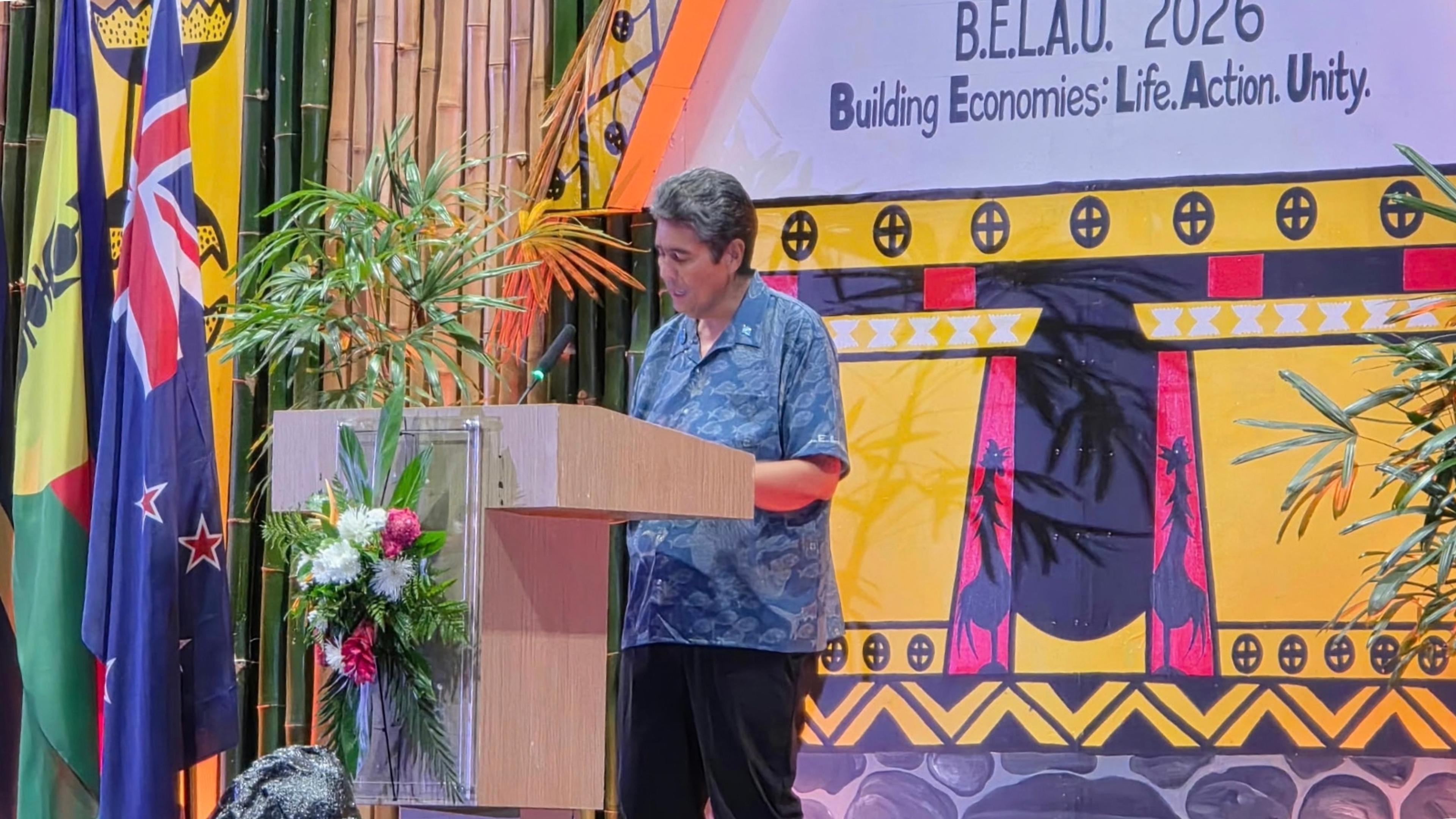
Palau President Surangel Whipps Jr gives his closing address at the Forum Leaders summit in Koror.
Photo/PMN News/Thomas Wynne
Opinion
Is an empty seat a silent seat? What Palau told us about Pacific unity
The leaders’ meeting exposed tensions within the region but also showed where island nations can still find common ground.

Thomas Tarurongo Wynne
Published
08 September 2026, 9:33am
Share
Copy Link
Top stories
Top stories
The 55th Pacific Islands Forum Leaders Meeting closed in Koror last week with a raft of bilateral meetings, side events and financial commitments from donor partners including New Zealand, the United States and Australia.
The week culminated in the Leaders’ Retreat and a communiquē setting out what was agreed by our Pacific Leaders. However, the story most likely to outlast the communiquē is the one of empty chairs.
Five of the Forum's 18 members, Fiji, Vanuatu, Sāmoa, Kiribati and New Caledonia, were represented in Palau without their head of government. A sixth, Solomon Islands, sent its Prime Minister, then watched him fly home within a day after a no-confidence motion was filed against his government. The motion was withdrawn on Sunday.
That left Foreign Minister Rick Houenipwela to carry his country's voice into the Troika press conference, and it left the region's stated solidarity looking thinner than expected.
Forum Chair and Palau President Surangel Whipps Jr told the media that “our unity is our solidarity as a region, and it is essential.”
Nobody in that room disagreed with him. Though many officials I spoke to were left wondering whether unity can be declared when so many of the family's leaders are not at the table. Something Pacific and world media captured too.
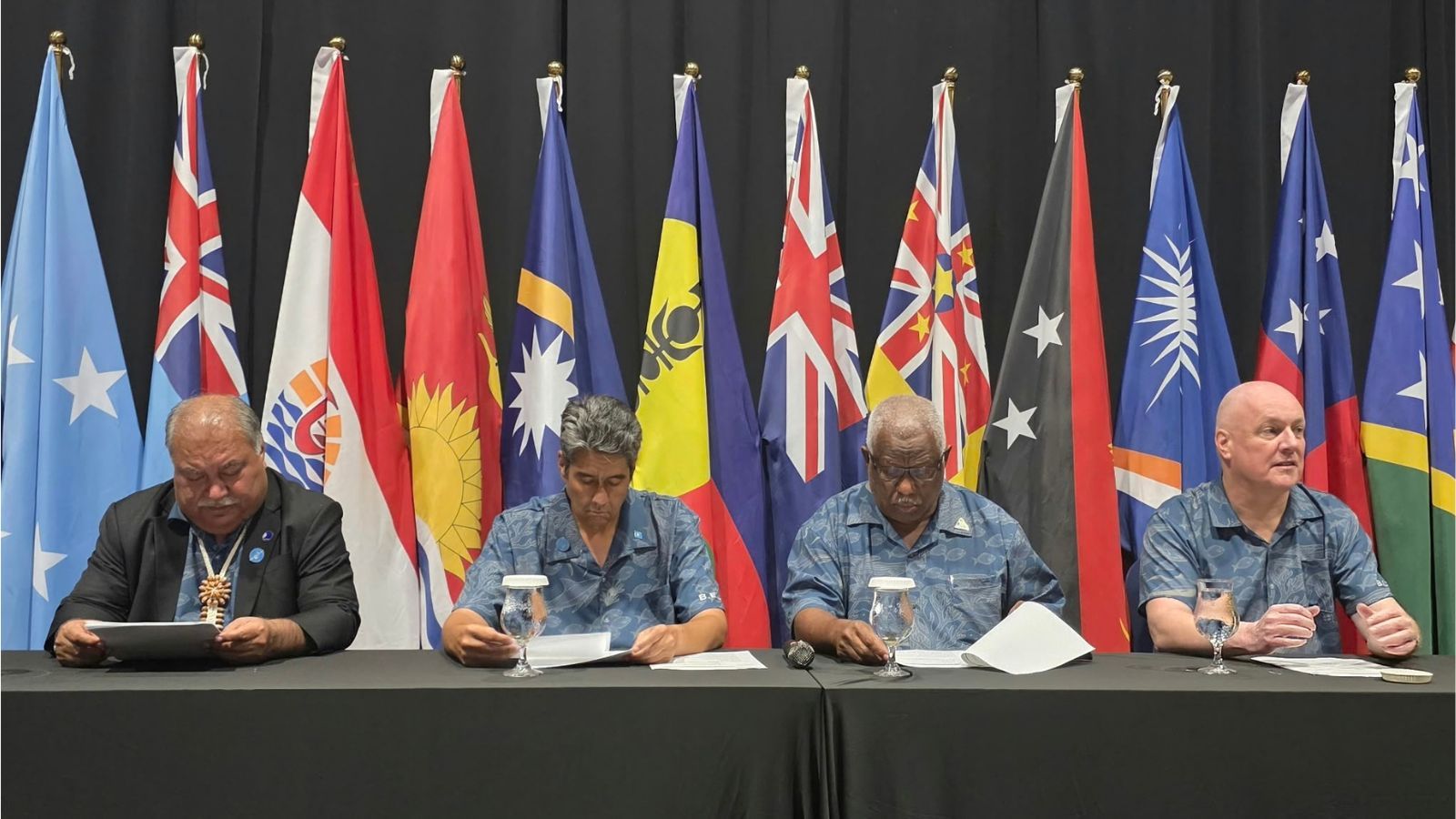
Pacific Leaders Forum Communique delivered by Secretary-General Baron Waqa, with Palau President Surangel Whipps Jr, Solomon's Foreign Affairs Minister Rick Hounipwela, New Zealand Prime Minister Christopher Luxon Photo/PMN News/Thomas Wynne
New Zealand's Foreign Minister Vaovasamanaia Winston Peters called the absences “seriously disappointing,” though he added that the delegations that did travel were strong ones nonetheless.
Asked directly whether foreign interference had shaped who stayed home, Peters told reporters “you'd be defying gravity and logic if you said it wasn't a big problem”, without naming a state or making a formal accusation.
Clearly, the China-Taiwan question smouldered beneath much of the tension. Palau, one of the Pacific's few remaining diplomatic partners of Taipei, allowed Taiwan to participate as a development partner alongside China as a dialogue partner.
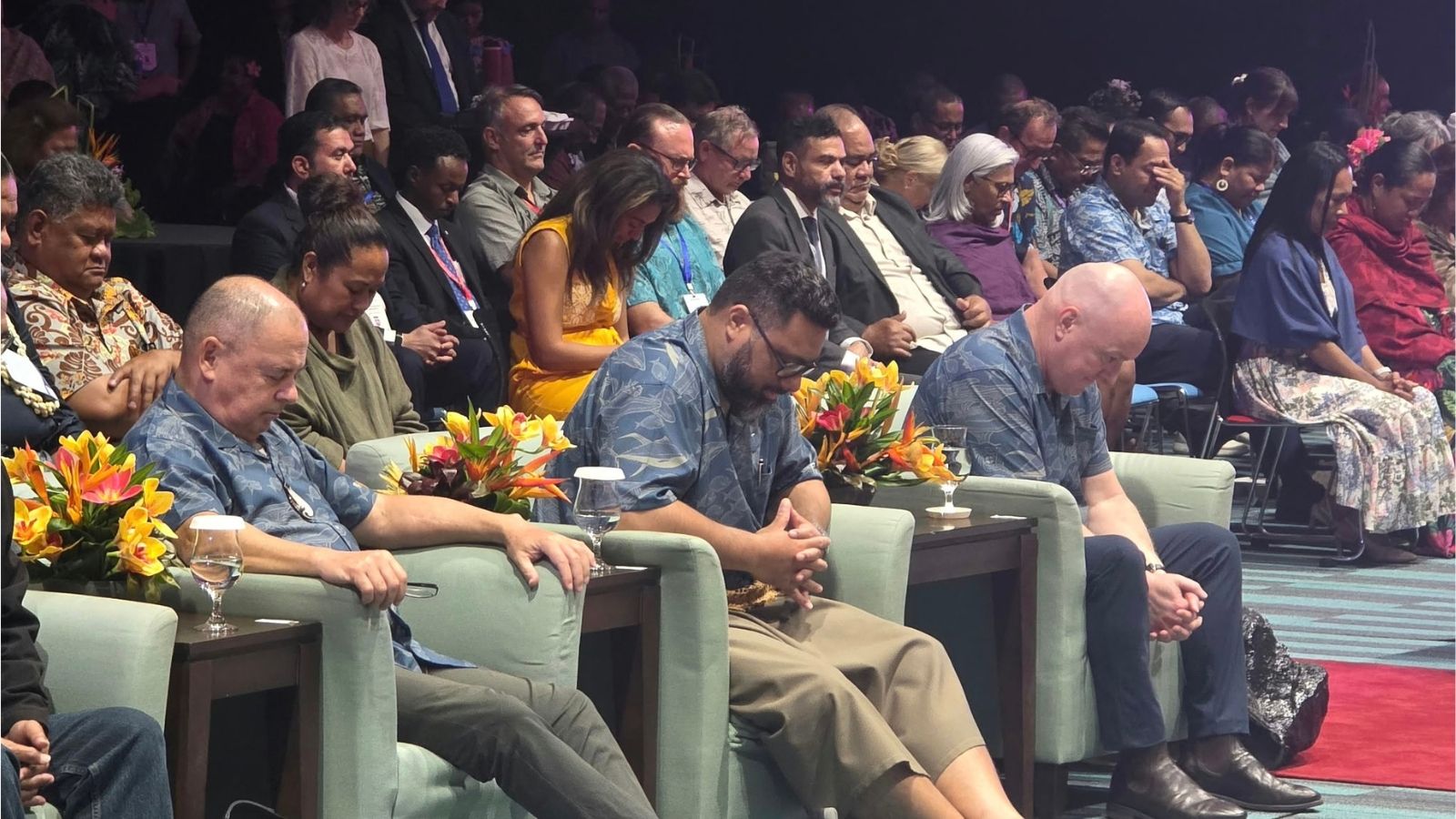
Pacific Leaders Forum closing Cook Islands Prime Minister Mark Brown, Tonga Prime Minister Lord Fatafehi Fakafanua and New Zealand Prime Minister Christopher Luxon Photo/PMN News/Thomas Wynne
The decision angered Beijing, which warned “there would be consequences.” Whether that decision, or the broader contest of China and Taiwan, influenced leaders’ decisions not to attend will now be consigned to Pacific political history and conjecture.
Then there was Naoero, formerly Nauru. Item 29 of the communiquē registered deep concern over China’s recent intercontinental ballistic missile test, conducted without adequate notice, which overflew several Pacific members.
The communiquē called for at least 24 hours advance warning on future tests, and asked all states to act consistently with sovereignty, the Treaty of Rarotonga and the Blue Pacific Ocean of Peace Declaration. But China is not mentioned, Naoero’s dissented from the paragraph, and Kiribati was absent from the Leaders’ Retreat where the decision was made.
That a Pacific state chose to stand apart on a question of nuclear-era security, in a region that has fought hard for the protections in the Treaty of Rarotonga, captures the complexity our Pacific leaders face. And what coming together asks Pacific nation states and their leaders to navigate.
Yet there was another side to the Palau meeting. On climate change, the region was far more united. Leaders renewed their commitment to keeping 1.5°C within reach and adopted the Palau Declaration for urgent and inclusive climate action.
In a region where climate change remains an existential concern, perhaps this is also what Pacific unity looks like: finding common ground on the issues that most directly affect our people, even when agreement becomes harder on questions of geopolitics and security.
Watch Thomas Tarurongo Wynne's update from Palau below.
Leaders also agreed to move forward with reforms to the region's architecture, an acknowledgement that the Forum itself may need to change if it is to manage an increasingly complex Pacific.
Houenipwela, chairing the Forum's foreign ministers meeting earlier in the year in Suva, offered a very sobering description of how Pacific unity actually functions under pressure. “This does not require members to hold the same position on every issue,” he said of the Pacific Way.
And if that is true, then the empty chairs in Palau and the single dissent on ballistic missiles, item 29, may not as the Minister alluded to, be a Forum in crisis. They may simply be evidence of 18 sovereign states behaving like 18 sovereign states.
Further clarifying his thoughts he said, "it requires us to listen carefully to one another, respect national circumstances and perspectives, and continue working towards positions that genuinely reflect the collective interests of our Forum family."
Absolute agreement, in Houenipwela’s mind, was not a prerequisite for unity nor a demonstration of the Pacific way. Is this the lens he offers for our understanding of when we meet and gather, what Pacific unity is, and that an empty seat is not also a silent seat
The 55th Pacific Islands Forum Leaders Meeting was held in Koror, Palau, held from 30 August to 4 September.